
A homeowner once showed us the photo of their house from the previous December. They had bought bright strings from a big box store, hung them carefully and still felt something was off. The roofline looked patchy. Some bulbs were brighter, a few had faded to a different shade, and the spacing wandered from one section to the next.
Nothing was wrong with their effort. The lights simply were not built for the job. If you are asking what the best Christmas lights to use on my roofline are, the answer is clearer than the shelves at the store make it seem.
We are Elves Holiday Lighting in Howell, and we have lit rooflines across Livingston County for six seasons. Here is what we use, why we use it and how to choose what fits your home.
The short answer
For most homes, the best choice is commercial grade LED C9 bulbs on 12 inch spacing, installed with clips matched to the roof edge. Warm white is the safest color. It looks clean on nearly every house and rarely goes out of style.
That is the setup we put on every roofline. The rest of this guide explains the reasons, so you can judge any quote or product for yourself.
Roofline bulb types compared
Bulb size changes how a roofline reads from the street. Here is how the common types compare.
C9 LED, the standard for rooflines
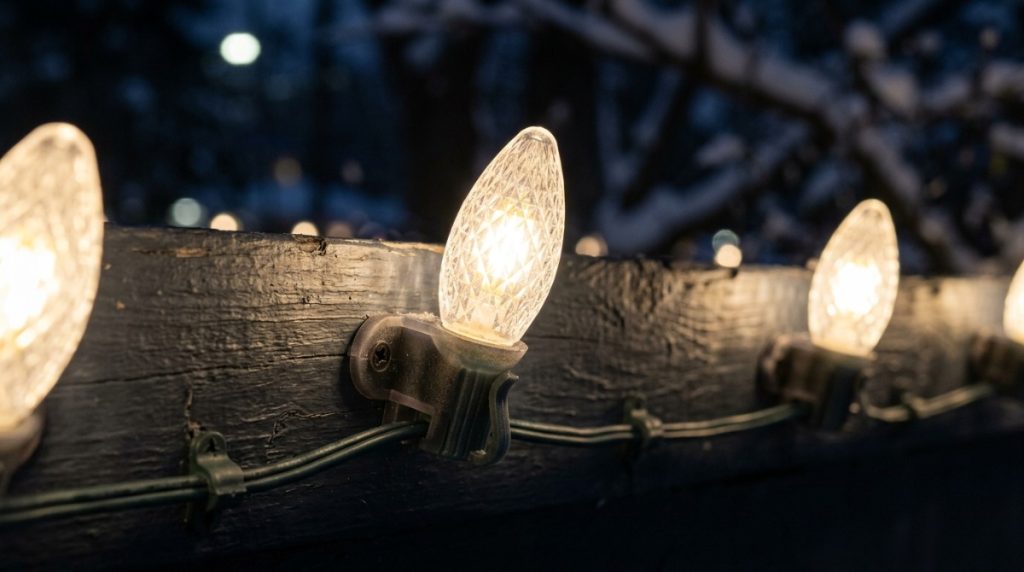
C9 bulbs are about the size of a large strawberry. They are bold enough to read clearly from the street, even on a two story house. They sit well on a roof edge, they are easy to space evenly and they hold a steady line.
That is why professionals reach for C9 first. It gives you the classic, full look people picture when they imagine a lit house.
C7, when it fits better
C7 bulbs are a size smaller. They can suit a smaller home or a more delicate look, especially on a low, single story roofline. They are a fine choice in the right setting. On a taller house, they can look a bit thin.
Mini lights, for trim, windows and wreaths
Mini lights are small and fine, so they are great for detail work. We use them on windows, doors, wreaths and shrubs. On a long roofline, they tend to disappear from the street.
Icicle and net lights, where they belong
Icicle lights hang down from the roof edge and give a frozen look. They are pretty on an eave, but they add a lot of strands and more to hang. Net lights are made to drape over bushes and hedges, and they are not meant for rooflines.
Why we do not mix types on one roofline unless the design calls for it
Mixing sizes on one line makes it look uneven. A C9 next to a mini light or a C7 changes the rhythm of the whole run. Unless a design calls for a deliberate layered look, we keep one bulb type per roofline so the line stays clean.
What “commercial grade” actually means
You will see the words “commercial grade” on lots of packaging. Here is what we mean by it, in practical terms.
Socket and wire quality
The socket is where moisture and cold cause most failures. Commercial products tend to have stronger sockets that seat firmly, plus thicker, more flexible wire that holds up better in cold. Cheap sockets can loosen, and thin wire can crack when the temperature drops.
LED lens and color consistency
Good LEDs give you consistent color from the first bulb to the last. Cheaper strings can vary, which is how a roofline ends up with a few bulbs that look slightly yellow or blue next to the rest. That patchy look is one of the most common complaints we hear.
Weather resistance and cold performance
Michigan gives lights a hard time. Cold, wet snow and wind all work on bulbs and sockets for weeks at a time. Commercial products are built for that kind of exposure and are meant to be used outdoors for the whole season. Look for safety listings, such as UL, on anything you buy.
Warranty and why we install only our own lights
We install only our own commercial grade LED lights. We do not install lights a customer already owns, for quality and liability reasons.
Here is the reasoning. If a bulb we did not choose fails in January, we cannot stand behind it, and the homeowner is left with a dark spot on the house. Using our own products lets us offer a full season warranty and service guarantee. If a light or decoration has an issue, we fix or replace it at no extra charge.
LED versus incandescent on a roofline
LEDs have taken over for good reasons.
- Energy use. LEDs use far less electricity. The U.S. Department of Energy notes that LED lighting uses at least 75 percent less energy than incandescent lighting. You can read more in its LED lighting guide.
- Heat. LEDs stay cool to the touch, which is easier on sockets, wires and nearby surfaces.
- Lifespan. LEDs last much longer, so you are not replacing bulbs year after year.
- Strands per circuit. Because LEDs draw so little power, you can connect more strands on one circuit. Always follow the manufacturer’s maximum for connected length.
Older incandescent lights have a warm glow people love, and modern warm white LEDs come close to matching it.
Choosing color
Color is where a roofline gets its personality.
Warm white versus pure white
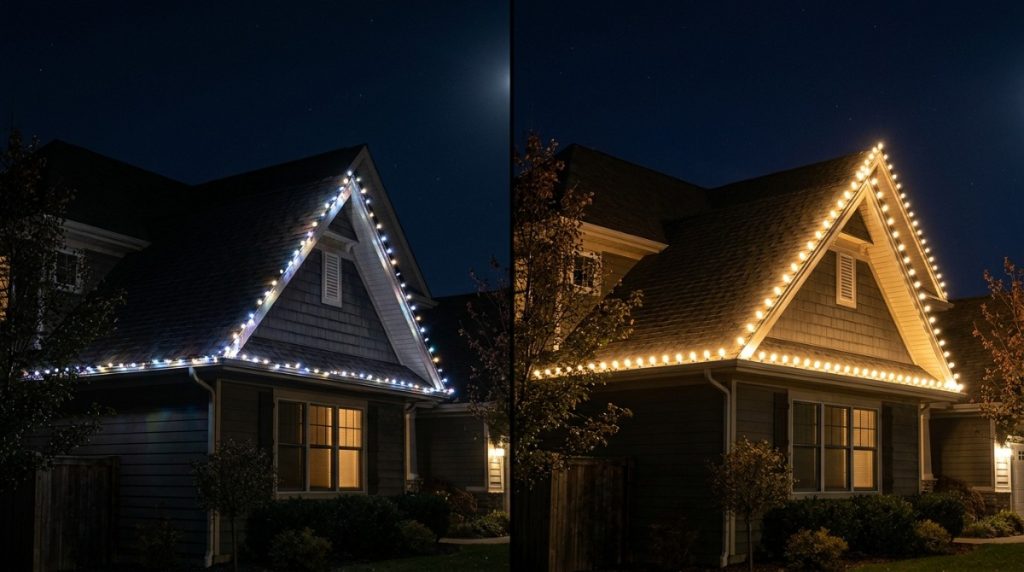
Warm white has a soft, golden tone. It looks cozy and traditional, and it flatters brick, wood and darker siding. Pure white is crisper and bluer. It can look sharp and modern, especially on a white or gray house.
The difference comes down to color temperature, which describes how warm or cool a light appears. You can learn more in this overview of color temperature.
If you are not sure, go with warm white. It is the safest choice for most homes.
Multi color and red and white patterns
Multi color gives a playful, festive look that many families love. A red and white alternating pattern feels like a candy cane and is fun on a smaller home. Both can look great, but they are bolder choices. They work best when the rest of the display follows the same spirit.
How to test color from the street
Do not judge color up close. Hold a sample strand against your house, then step across the street at dusk and look. Colors that seem warm in your hand can read quite differently from fifty feet away.
Our free digital rendering helps here too, since you can see your own house before anything goes up.
Spacing and quantity
Spacing affects how smooth the line looks.
12 inch spacing and why it reads well from the street
Twelve inches between bulbs gives a continuous line when viewed from a distance. Closer than that, the roof can look crowded. Farther apart, you start to see gaps.
Measuring the roofline and adding for corners
Measure the actual length of the line, including peaks, returns and gables. Then add a little extra for corners and turns. We cover how to count footage in more detail in our guide to permanent Christmas lights cost per foot.
Quick formula for number of bulbs
At 12 inch spacing, you need about one bulb per foot. A 100 foot roofline needs roughly 100 bulbs. Add about 5 to 10 percent for corners and spares. That is a good starting point, not a final quote.
Clips and mounting for each roof edge
The best bulb in the world still needs a good mount. Clips should match the surface they attach to.
- Gutters: gutter clips made for your gutter type
- Fascia and drip edge: fascia and edge clips
- Siding and trim: siding and trim clips
- Metal roofs: magnetic clips
We avoid nails and staples, because they can damage the roof and trim. If you want more detail, see our guide on how to hang Christmas lights without gutters.
Practical example: one roofline, three looks
Here is how color alone changes a house. We keep the example general, since every home is different.
Picture a two story home with a brick front. With warm white C9 bulbs, the roofline looks classic and the brick glows. Switch to pure white and the house feels crisper and a little more modern. Go to multi color and the same house feels playful and bright.
None of those looks is wrong. They just say different things. Many customers are surprised how different the same roofline feels, which is why we like showing a rendering first.
Why professional lights beat big box strings on a Michigan roofline
We want to be fair here. Big box lights are fine for small, short term jobs, like a porch rail or a single window. If you are lighting a small area and you do not mind replacing a string now and then, they can work well.
A full roofline is a different story. It is long, high and exposed to wind and snow for weeks. Professional lights hold up better because of stronger sockets, thicker wire, steadier color and a warranty behind them.
Cheaper strings can also be tough to line up evenly, and a single failure can darken a whole section. That is how the patchy look in our opening story happens.
Frequently asked questions
Are C9 lights good for rooflines?
Yes. C9 is the most common choice for rooflines because it reads clearly from the street and gives a full, classic look.
Warm white or pure white?
Warm white is the safest pick for most homes. Pure white suits crisp, modern homes. Test both from across the street.
How many lights for 100 feet?
At 12 inch spacing, about 100 bulbs, plus 5 to 10 percent extra for corners and spares.
Do LED lights work in Michigan winters?
Yes. LEDs handle cold well, and commercial grade products are made for outdoor use through the whole season. Cheap sockets and thin wire are usually what fail.
Why do you only install your own lights?
Quality and liability. Using our own commercial grade products lets us stand behind the work with a full season warranty and a fast fix if anything goes wrong.
See your roofline before you commit
Choosing lights is easier when you can see the result. Request a free design and digital rendering, and we will show you your own roofline in the style you like.
Learn more about our residential holiday lighting, read our FAQ or contact us for a free estimate. You can also call us at (810) 522-8950.
