
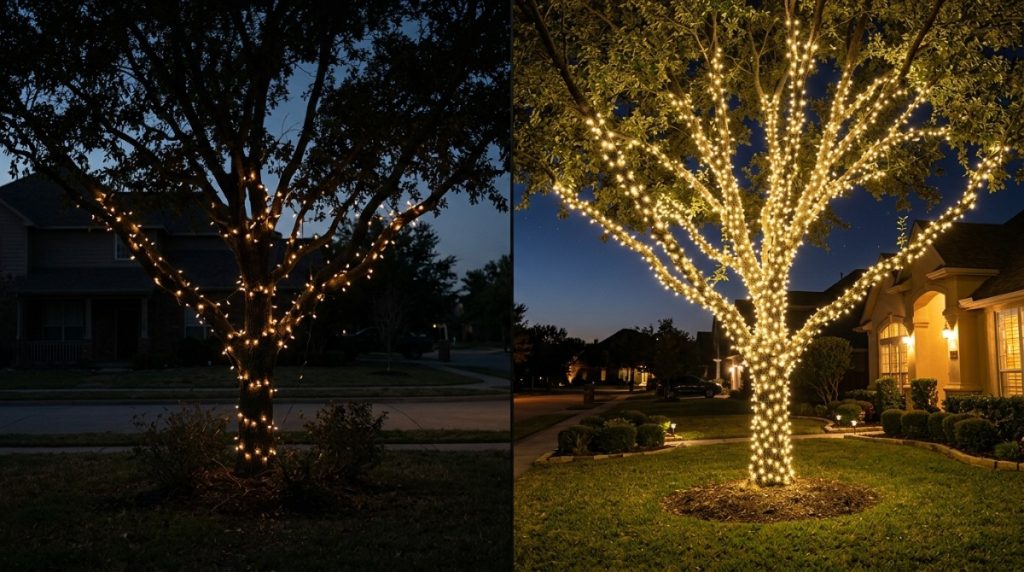
A homeowner once showed us a tree they had wrapped with retail lights. They had spent hours on it. From the street, it looked thin. A few strands had faded, and the trunk wrap barely showed after dark.
It was not the effort that fell short. It was the choice of lights. Different parts of a tree need different bulbs, and the best lights to wrap trees are not the same as the best lights for a roofline.
We are Elves Holiday Lighting in Howell. We decorate trees small and large, and we know what holds up through Michigan winters. Here is a tree by tree guide.
The short answer
For trunks and main branches, use commercial grade LED mini lights, usually in warm white. For big canopy accents, larger bulbs work well. Net lights are for shrubs only.
A quick summary:
- Trunks and main branches: commercial grade LED mini lights
- Large canopies: larger bulbs for bold accents
- Shrubs and hedges: net lights
- Color: warm white is the safest choice
Now let us break down the options.
Light types compared
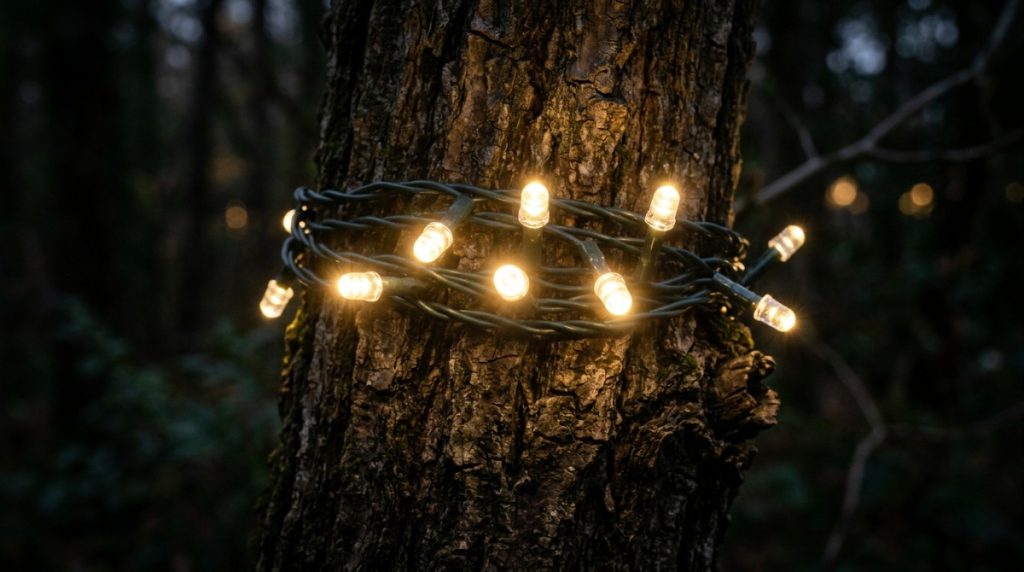
5mm LED mini lights
The 5mm LED mini light is the workhorse for wrapping. The bulbs are small and bright, and the wire is thin and flexible, so it wraps neatly around trunks and branches. Good commercial versions hold their color and last through a long season.
M5 and scatter style lights
M5 lights are a little rounder and give a soft, scattered glow. They work well on bushes and fuller trees where you want a gentle sparkle instead of a tight line of light.
C6, C7 and C9 on larger trees
Larger bulbs show up from farther away. C6 is a small visible bulb. C7 and C9 are bigger and bolder. On a tall tree, these bulbs add accents that read from the street. If you want to compare the bigger sizes, see our guide to C7 vs C9 Christmas lights and our look at whether C9 lights are too big for a Christmas tree.
Net lights and trunk wrap nets
Net lights are a grid of lights made to drape over shrubs and hedges. They save time on bushes, but they are not made for tree trunks or branches. Wrapping a trunk with a net usually looks uneven.
Cascading and icicle strands for canopies
Cascading strands hang down from higher branches and give a falling light effect. They can look beautiful on big trees, but they add a lot of strands and take more time to hang well.
Choosing color
Warm white as the safe choice
Warm white is soft, golden and flattering on bark and branches. It works with almost every home and almost every tree. If you are unsure, start here.
Pairing warm trunk with cooler canopy
Some designs use warm white on the trunk and a slightly cooler white on the canopy. The contrast gives depth. Keep the difference gentle, or the tree can look mismatched.
Multi color for small ornamental trees
Multi color lights look cheerful on small ornamental trees. They suit a playful yard, but they are a bolder choice. Match the style to the rest of the house.
Wire color and bark
Wire color matters more than people think. Green wire blends into evergreens and foliage. Brown or dark wire blends into bark. White wire can show up on dark bark, which makes the wrap look messier in daylight. Choose a wire that disappears into the tree.
Matching the light to the tree
Each type of tree has its own shape and needs.
Deciduous hardwoods
Maples and oaks lose their leaves, so in winter the branches are bare and the structure shows. You can read more about deciduous trees. Wrapping the trunk and main limbs with mini lights makes the shape stand out. Larger bulbs can add accents in the canopy.
Evergreens and conifers
Evergreens and other conifers have thick needles and dense branches. Lights can get lost inside. Mini lights strung along the outer branches and a few larger bulbs help the tree glow without disappearing.
Small ornamental trees
Smaller trees look best with fine mini lights, which keep the scale right. Big bulbs tend to crowd them.
Multi stem and palm style shapes
Trees with several stems or an unusual shape need care. Wrap each stem separately so the lines look neat from the street.
What to look for in outdoor tree lights
Here are the features that matter when you shop:
- Weather rating. The lights should be made for outdoor use for the full season.
- Wire flexibility. Cheap wire gets stiff in the cold and cracks. Flexible wire wraps easier and lasts.
- Connectors. Sturdy connectors keep moisture out and hold in cold.
- Warranty. A real warranty shows the maker stands behind the product.
- Commercial versus retail. Commercial grade lights use stronger parts and are made for long outdoor use. Look for safety listings such as UL.
The U.S. Department of Energy explains why LED is the better choice outdoors in its LED lighting guide. LEDs use less energy and stay cooler, which is better for cords and branches.
We use commercial grade LED lights only. That lets us offer a full season warranty and service within 48 hours if something goes wrong.
How these lights hold up in Michigan
Michigan winters are a real test.
- Cold. Cheap wire can get stiff and crack. Quality LEDs handle it.
- Wind. Open yards in Livingston County can get strong gusts that tug on strands. Secure wrapping matters.
- Snow. Snow piles up on branches and strands, which adds weight.
- Ice and freeze and thaw. Moisture can get into poor connectors and sockets.
Good lights, secure wrapping and a bit of slack let the tree move without damage. Our crew checks the work through the season, and we take everything down in January.
Spacing, coverage and how many strands you need
Even good lights look weak if there are too few of them. This is the most common reason a wrapped tree looks sparse from the street.
A trunk wrap works best when the strand spirals up in even, close turns. If the turns are too far apart, the trunk looks striped instead of glowing. For the main branches, wrap out along each limb, then return along the same limb so the light looks full from every angle.
Tree size changes the math quickly. A small ornamental tree may need only a few strands. A large mature tree with many limbs can need far more than most homeowners expect, because every branch you wrap adds length. When in doubt, plan for more coverage rather than less. It is easier to enjoy a full, glowing tree than to wish you had bought extra.
Plan your power, too. LED lights draw very little electricity, but long runs need to stay within the manufacturer’s maximum connected length. Use outdoor rated cords, keep connections off the wet ground and cover plugs if you can.
Keeping the tree healthy
A wrapped tree should still be a happy tree. A few habits protect it.
- Wrap loosely. Lights should be snug enough to stay put but loose enough that branches can grow.
- Check each season. Cords that held fine last year can be tight this year. Loosen them or replace them.
- Take lights down after the holidays. Leaving them up for months, or years, is how cords end up embedded in bark.
- Handle branches gently. Bending or pulling thin limbs can break them, especially in cold weather.
Our crew wraps with care and removes every light in January, so the tree is left as we found it.
Practical example: one yard, three trees
Here is a general example of how the right light changes the result.
A mature maple by the driveway looks best with mini lights wrapped up the trunk and main limbs, plus a few larger bulbs in the canopy. The structure is clear from the road, even in bare winter.
A spruce near the walkway needs lights along the outer branches so they do not vanish into the needles. A mix of fine bulbs and bigger accents keeps it glowing.
A small ornamental tree by the porch gets fine mini lights in warm white and a simple, neat wrap.
One customer replaced their retail lights with a professional wrap and was surprised how much fuller the tree looked. Same tree, better lights, and a more even spacing along the branches.
Common buying mistakes
These are the ones we see most often:
- Using net lights on trunks. They sag and look uneven.
- Buying too few strands. A thin wrap looks sparse from the street.
- Picking the wrong wire color. Visible white wire spoils the look in daylight.
- Choosing cheap lights that fade. Color shifts and dead sections show up quickly.
- Wrapping too tightly. Tight wrapping can rub bark as the tree grows.
- Going too big on a small tree. Large bulbs crowd it.
Frequently asked questions
Are mini lights best for trees?
For trunks and main branches, yes. They wrap neatly and give a steady, even glow.
Should I use net lights?
Net lights are best for shrubs and hedges. They do not wrap trunks or branches well.
Can I wrap trees with C9?
On large trees, C9 bulbs can add bold canopy accents. For trunks and small trees, mini lights usually look better.
Warm or cool white?
Warm white is the safest choice for most homes and trees. A gentle mix can add depth.
How long do commercial tree lights last?
Quality commercial LEDs are built for many seasons of outdoor use. Lifespan depends on weather, mounting and care.
See your trees lit before we hang a single strand
The best way to choose is to see it. Request a free digital rendering, and we will show you your trees with different lights and colors.
Learn more about our residential holiday lighting, read our FAQ or contact us for a free estimate. You can also call us at (810) 522-8950.

One Response