
Every storm season, the phone rings. A homeowner has spent a weekend wrapping a tree, and then the wind came through. Strands have slid down the trunk, a few drapes have blown off the canopy and one plug is hanging by its cord.
When we look at those trees, the lights usually did not fail. The fastening did. A strand tied only at the start, with nothing at the forks and no slack for sway, has very little chance in a strong gust.
Here is our promise, and our honest limit. No method is storm proof. What we can do is make movement unlikely and teach you what to check afterward. This guide shows how to secure Christmas lights to a tree in a way that holds up to Michigan weather.
The short answer
Fasten at the start and end of every strand. Add fasteners at branch forks. Leave some slack so the lights can move with the tree. Never use nails or staples. Check the lights after every storm.
A quick list:
- Fasten both ends of each strand
- Add fasteners at forks and spiral turns
- Leave gentle slack for sway
- Avoid nails, tacks and staples
- Check after storms
Now let us look at why lights move in the first place.
Why tree lights move in wind and storms
Understanding the cause makes the fix easier.
Branch sway and trunk flex
Trees are not rigid. In wind, branches bend and trunks flex. A strand fastened too tightly in one spot can be pulled loose, and a strand fastened nowhere simply slides.
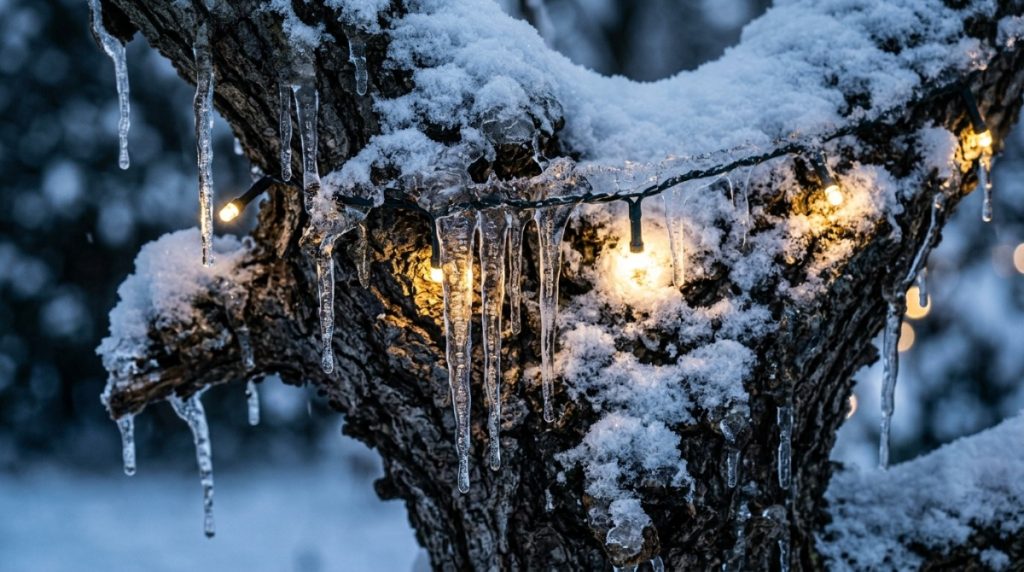
Smooth bark versus rough bark
Smooth bark gives lights little to grip, so strands slip down. Deeply furrowed bark holds a wrap better, but it can hide loose spots. Each type needs a slightly different approach.
Wet snow and ice weight
Michigan storms often bring wet snow and ice. These add real weight to strands and branches. Heavy loads can pull lights down or snap fasteners. You can read more about how these events work in this overview of an ice storm.
Loose plugs and connections
Plugs and connectors are common weak points. Wind can tug them apart, and moisture can sneak in. A plug that is secured and protected stays connected and safer.
Fastening methods compared
Tree safe clips
Clips made for trees hold lights to branches without damaging bark. They are quick to place and easy to remove. They work well at forks and along limbs, and they are our first choice for most trees.
Zip ties and cable ties
Zip ties can work as a short term fix for a loose strand, but they come with a serious catch. A tie left on a growing branch can tighten and cut into the bark over time. If you use ties, keep them loose, check them regularly and remove them after the season. Many tree care professionals prefer clips for this reason.
Twine, tape and wire at plugs
Soft twine or tape can secure a plug or connector, so it does not dangle. Use materials that will not cut into bark, and keep them off the tree itself where you can.
Friction wrap on deeply furrowed bark
On rough bark, a snug wrap can hold by friction alone, especially at the trunk. It still helps to add fasteners at the start and end of each strand.
Never use nails, tacks or staples
They injure the tree and create openings for disease and pests. They also tend to loosen as the tree moves. There is always a gentler way.
Where to fasten
Placement matters as much as the method.
Start and end of each strand
Anchor both ends. If either end is free, the strand can unwind or slide. This is the single most important rule.
Branch forks and spiral turns
Forks are natural anchor points because the branch structure holds the strand in place. Add a fastener at each fork. On trunk wraps, add one every few turns so the spiral keeps its shape.
Plugs and connectors
Secure every plug and connector so wind cannot pull them apart. Keep connections off the wet ground and covered when you can.
Slack, spacing and tree health
How much slack to leave
Leave enough slack that the lights can move with the tree without pulling tight. On a spiral, that means a relaxed wrap rather than one pulled hard. On a drape, it means a gentle curve rather than a straight line.
Too tight and the strand snaps under sway. Too loose and it slides or tangles. The goal is firm but forgiving.
Why tight wraps can hurt a tree
A wrap pulled tight can press into bark. As the tree grows, it can restrict growth, and over time it can cause girdling, which is damage that cuts off the flow of nutrients. You can read more about girdling. Loose wraps and seasonal checks prevent this.
Removal timing
Take lights down soon after the holidays. We begin takedown in the first week of January. Leaving lights up through spring and summer is when cords can start to embed in growing bark.
Common mistakes that let lights move
Most callbacks after a storm come from the same handful of habits.
Fastening only the start. A strand anchored at one end can slide, unwind and tangle. Both ends need to be fixed.
Pulling the wrap tight. It feels secure, but tight wraps snap under sway and can harm bark. Firm and forgiving is the goal.
Ignoring the forks. Branch forks are the best anchor points on a tree. Skipping them leaves long spans that catch the wind.
Leaving plugs hanging. A dangling plug is an easy target for gusts, and a wet one is a safety problem. Secure it and keep it off the ground.
Using weak or cheap lights. Thin wire and flimsy sockets fail in cold and wind. Sturdy, commercial grade lights hold together better when the weather turns. We install only our own commercial grade LED lights, which is one reason we can stand behind them.
Never checking. A strand that shifts a little in October can be on the ground by December. A quick look from the yard every week or two catches problems early.
Michigan weather: what to expect
Our weather is a real test for tree lights, so it helps to know what the season brings.
Late fall often brings strong, gusty winds. This is when loose strands and hanging plugs show up. Early winter brings wet, heavy snow, which can weigh down strands and branches. Midwinter adds cold snaps and ice, and the freeze and thaw cycle puts stress on cords, connectors and fasteners.
Open yards, hillsides and trees near fields get the worst of it. If your tree stands alone in the open, plan for extra fasteners and a more careful check after each storm. Trees sheltered by a house or other trees usually face gentler conditions.
None of this means you should skip lights. It means you should plan for the weather, rather than hope.
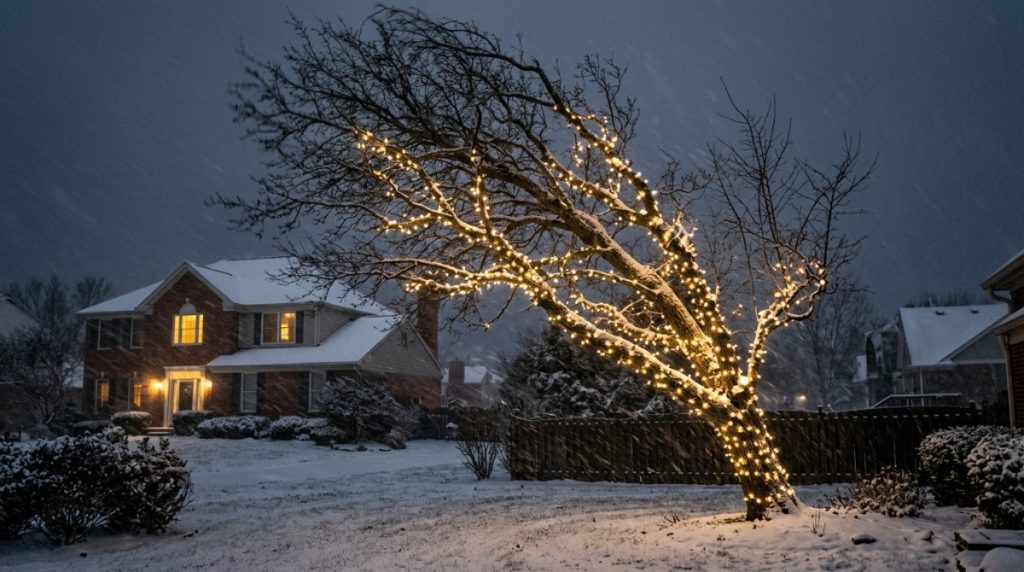
Preparing for a Michigan storm
A little preparation goes a long way.
Before the forecast
- Walk around and look for loose strands, hanging plugs or sagging drapes.
- Re-secure anything that has shifted.
- Check that connections are tight and off the ground.
- If a severe storm is predicted, consider unplugging the lights.
After the storm
- Wait until it is safe, and stay away from downed branches and power lines.
- Look for strands that have slipped, fallen or tangled.
- Check plugs, connectors and cords for damage.
- Re-secure what has moved, and replace anything that is damaged.
- Never climb a ladder in wet, icy or windy conditions.
If lights have come down and the job is too high or too risky, call for help.
Practical example: a windy hillside tree
Here is a general example of how we think about an exposed tree.
Picture a large tree on an open hillside, where wind hits it hard. We anchor every strand at both ends, add fasteners at every major fork and keep the spiral on the trunk even, with a few anchors along the way. Plugs get secured and kept up off the ground. We leave gentle slack on drapes so the canopy can sway.
Even with that care, we tell homeowners the same thing. A strong enough storm can still move something. That is why we check in-season and why a fast fix matters.
One customer called after a windy week, and a few strands on the canopy had shifted. Because the strands were anchored at both ends, the problem was small and easy to correct. A quick visit put everything back in place.
What our warranty covers when lights shift
Every Elves installation includes a full season warranty and service guarantee. If lights fall or bulbs go out, we will be out to fix them, usually within 24 to 48 hours.
We keep it simple. If something moves, you call us, and we take care of it. For anything specific to a storm, ask us when you book, and we will explain how it works.
We also take everything down in January and store it in our heated warehouse, so there is nothing left in the tree to cause trouble later.
Frequently asked questions
Do zip ties hurt trees?
They can. A tie left on a growing branch can tighten and cut into bark. If you use them, keep them loose, check them often and remove them after the season. Clips made for trees are a gentler choice.
How often should I check lights after a storm?
After every significant wind, snow or ice event. A quick walk around from the ground is usually enough to spot a problem.
What do I do if lights fall?
Unplug them if it is safe to do so. Do not climb in wet or icy conditions. Wait for a clear, dry day, or call a professional. If you are an Elves customer, call us.
Can wet snow pull lights down?
Yes. Wet snow and ice add weight to strands and branches. Strong fastening, sturdy lights and gentle slack help, but heavy loads can still move things.
Does the warranty cover storm damage?
Our full season warranty and service guarantee covers fixing lights that fall or stop working. If you have a storm related question, ask us when you book.
Get lights that stay put
If you would rather not worry about the wind, we would be happy to help. Request a free estimate, and our crew will design, install and maintain your tree lights through the season.
Learn more about our residential holiday lighting, read our FAQ or contact us. You can also call us at (810) 522-8950.
