
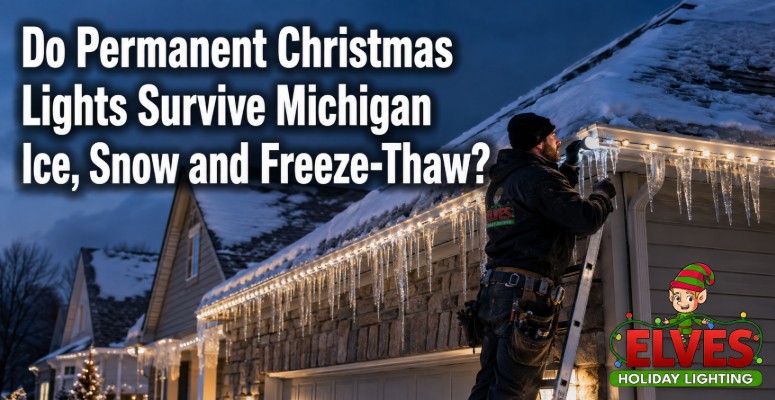
Suggested featured image: A Livingston County eave in January, permanent lighting channel visible under a ridge of snow with icicles at the gutter line. Alt text: Permanent christmas lights michigan winter roofline with snow and ice at the gutter line
Do Permanent Christmas Lights Survive Michigan Winters? (Direct Answer)
Yes, quality permanent Christmas lights survive Michigan winters when properly installed. Premium systems use powder-coated aluminum channel, sealed connections and IP65 to IP67 weatherproofing, with operating ranges reaching minus 40 degrees F. The failures we see involve budget kits with adhesive or plastic-clip mounting that turns brittle in deep cold, unsealed joints that freeze-crack, and sloppy installs that trap water. The hardware tier and the installer decide the outcome.
Consider this our permanent christmas lights michigan winter field report, written from the roof edge rather than a showroom.
Here is what a January eave in Livingston County actually looks like. Ice ridged along the gutter line. Snow letting go of a steel roof in one heavy sheet. Cords stiff enough to hold their coiled shape in your hand.
Our crews spend every winter on these edges. We install in November cold, repair in January ice, and take displays down through March freeze-thaw. So when a dealer blog written in Utah or Texas promises your hardware will shrug all of this off, we can tell you exactly where that is true and where it is not.
What a Michigan Winter Actually Throws at Your Roofline
The question is not whether the LEDs work in cold. It is whether everything holding them to your house survives four months of abuse. Four mechanisms do most of the damage.
Freeze-thaw cycling
Water finds any gap. It slips into an unsealed connector joint or a hairline in a channel end cap on a 38 degree afternoon. That night it freezes and expands about 9 percent, prying the gap wider. Repeat that cycle forty times a winter and a small flaw becomes a dead section.
Snow load and snow-slide shear
Snow does not just sit on hardware. On steel and steep asphalt roofs it releases in sheets, and anything standing proud of the eave takes that sliding weight sideways. Screwed aluminum channel mounted tight to the fascia handles the shear. Surface-stuck clips take the hit like a hook takes a yanked cord.
Ice dams at the gutter line
Poorly ventilated roofs melt snow from underneath, and the runoff refreezes right at the cold eave edge. That is exactly where lighting channel lives. A dam can encase the channel in ice for weeks. Good systems sit flush and sealed and wait it out. Anything with exposed wiring at that line is in trouble.
Deep-cold brittleness and UV pre-aging
Plastics that flex fine at 20 degrees F can snap at minus 10. And the killer detail most people miss is summer. Two or three seasons of UV quietly age adhesives and plastic clips, so the third winter breaks what the first winter could not. Aluminum and stainless hardware simply do not play this game.
The Specs That Decide Survival
When you read a permanent lighting quote, four spec lines predict the winter outcome. Here is what they mean in plain English.
IP ratings translated
IP65 means dust-tight and protected against water jets. IP67 means it survives temporary submersion. For a Michigan eave that spends February under ice-dam meltwater, that gap matters. Premium systems run IP65 to IP67 on published specs. Budget kits often carry lower ratings, or rate the strip but not the connectors, which is where water actually gets in.
Temperature ratings
Premium dealer systems publish operating ranges in the minus 40 degrees F class. Plenty of budget kits are rated to around minus 4 degrees F. Howell has seen colder nights than that in recent winters. A rating is not a promise of instant failure below it, but it tells you what the plastics and seals were engineered for.
Channel material
Powder-coated aluminum channel, screwed into fascia, is the standard that survives here. Plastic tracks and adhesive mounting are the standard that does not. This single line item separates most winter survivors from most winter casualties we see.
Sealed connectors and drip-loop wiring
Factory-sealed connections keep freeze-thaw from ever getting a foothold. And a good installer leaves a small drip loop at every penetration so water runs away from the joint instead of into it. It costs nothing and saves systems. It is also the first thing missing on rushed installs.

| Spec | Premium dealer systems | Budget DIY kits |
| Weatherproof rating | IP65 to IP67, connectors included | Often IP65 or lower, connectors weakest point |
| Temperature rating | Minus 40 degrees F class | Around minus 4 degrees F class |
| Mounting | Powder-coated aluminum channel, screwed | Plastic clips or adhesive strips |
| Connections | Factory-sealed, drip-loop wiring | Push-fit joints, sealing left to the owner |
Brand-level detail on who builds what is in our permanent lighting brands comparison.
Why LEDs Themselves Love the Cold (and What Does Not)
Here is a nuance every blanket yes skips. LEDs actually perform better in cold. Lower temperatures improve their efficiency and extend diode life, which is why your display looks crispest on the coldest nights.
So the diodes were never the worry. The seals, plastics, adhesives and joints around them are. When a permanent system dies in a Michigan winter, it almost never dies of cold light. It dies of cold water and brittle mounting.
Our Permanent Christmas Lights Michigan Winter Report (What We See Locally)
Two rooflines from our winters around Livingston County tell the whole story.
The first is a dealer-installed aluminum-channel system we pass on a regular route. After a hard winter with two ice storms, it looked untouched at takedown season. Straight runs, dry joints, every section lit. The install discipline showed: flush channel, sealed ends, drip loops at every entry.
The second was a bargain kit, ordered online and stuck up with adhesive backing and plastic clips in October warmth. By February the clips were shedding onto the snow one by one, and a twenty foot section hung in a smile off the gutter. Same street, same winter, opposite outcomes.
The uncomfortable middle case is real too. We have seen same-tier hardware from the same brand age very differently on two houses, because one installer sealed and looped everything and the other did not. Winter grades the installer as hard as the catalog. That is the case we made for vetting the dealer over the brand, and it is doubly true here.
An Honest Winter Care Note for Permanent Systems
Dealers like to say no maintenance ever. Smart owners do a little anyway.
- Each fall, walk the house and eyeball the runs: any sagging sections, lifted channel ends, or cracked seals get a dealer call before the freeze, not after.
- Never chip or pry ice off the channel. You will damage seals the ice was not going to breach. Let it melt.
- Read your warranty’s weather language before you need it. Lifetime often covers the LEDs, while wind, ice and storm damage may sit under an exclusion, and labor usually expires long before the parts term. The fine print belongs in your decision, not your February surprise. We cover this and the rest of the honest tradeoffs in the downsides of permanent Christmas lights.
The mounting question matters double if you are considering self-installing a kit, which we walk through in our DIY vs professional permanent lighting guide.
FAQ
What temperature are permanent christmas lights rated for?
Premium dealer systems publish operating ranges reaching minus 40 degrees F. Many budget kits are rated to about minus 4 degrees F. Michigan sees nights below that budget threshold, so check the rating on the connectors and controller too, not just the light strip.
Can heavy snow rip permanent lights off the roofline?
Snow sliding off a steel or steep roof delivers a real sideways load. Screwed aluminum channel mounted flush to the fascia handles it season after season. Adhesive and clip mounting is what we find in the snow come February. The mounting method, not the snow, decides this one.
Do permanent lights cause or worsen ice dams?
No. Ice dams come from roof ventilation and insulation, not lighting channel. A slim flush-mounted track neither causes them nor prevents them. What matters is that your system is sealed well enough to sit under dam ice for weeks without taking on water.
Will cold make the lights dimmer?
The opposite. LEDs run more efficiently in cold, so displays look their sharpest on the coldest, clearest nights. Any dimming or flicker in deep cold points at a connection or controller problem, not the diodes.
Do warranties cover ice and storm damage?
Read the specific policy. Lifetime terms usually cover the LEDs and components against failure, while weather events sometimes fall under separate exclusions, and labor coverage is typically far shorter than parts coverage. Ask the dealer to point at the weather clause before you sign. Whether the whole investment makes sense for your tenure is a fair follow-up, and we work that math in our guide to whether permanent Christmas lights are worth it.
Plan Lighting That Respects a Michigan Roof

Whichever way you go, get advice from people who stand on these eaves in January. We will give you straight, winter-smart guidance on permanent hardware and mounting for your specific roofline, with no dealer commission behind the answer.
And if you would rather your lights never face February at all, our seasonal displays come down after the holidays and winter in our heated warehouse instead of on your eave.
Call Elves Holiday Lighting at (810) 522-8950 or book a free consultation. Michigan winter is not a rumor to us. Plan for the real one.
