
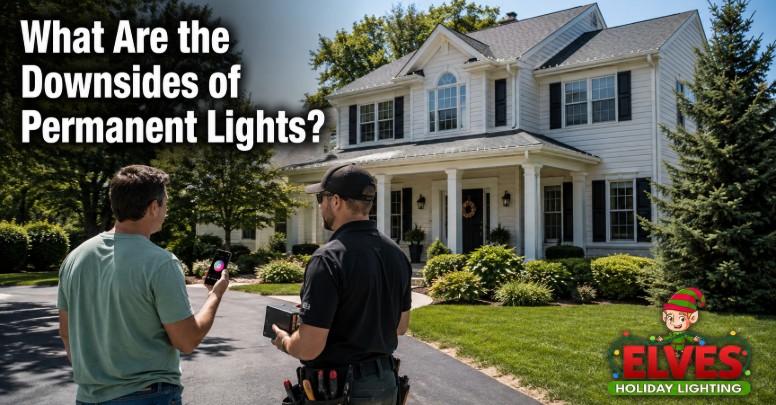
Drive around Livingston County on a July afternoon and you can play a quiet game we play from the truck: spot the track. On some rooflines, the permanent channel disappears unless you know where to look. On others, it shows against the fascia from the street.
That contrast is why this post exists. Homeowners ask us about the downsides of permanent lights on almost every consultation now, and they deserve the list before the purchase, not after.
One thing first: we advise both paths and earn our living either way, so we have no reason to scare you off. Several of these downsides have workarounds we will name. A few do not. Here is all of it.
What Are the Downsides of Permanent Lights? (Direct Answer)
The main downsides of permanent lights are high upfront cost ($3,000 to $8,000 for most homes), visible track in daylight, dependence on apps and Wi-Fi, repairs that need dealer parts, weather and UV wear, dealer lock-in, and a different look than classic C9 bulbs. They also light rooflines only, so trees, wreaths and garland still need seasonal work.
The nine downsides, ranked:
- Upfront cost and long payback
- Daytime track visibility
- LED dots vs classic C9 glow
- Rooflines only, no trees or wreaths
- App, Wi-Fi and controller dependence
- Dealer-only repairs
- Dealer lock-in and dealer churn
- Weather, UV and freeze-thaw wear
- Permanence itself
The Nine Downsides, Honestly Ranked
1. Upfront Cost and Long Payback
Most homes here need $3,000 to $8,000 installed, and the payback against professional seasonal service takes 3 to 5 years. Against DIY installs, it can take more than a decade. We ran the full numbers in permanent christmas lights cost.
Matters most if you may move within five years or the purchase would stretch the budget.
2. Daytime Track Visibility on Your Fascia

The system lives on your house every day of the year, and daylight is eleven months longer than December. In Michigan, short winter days mean you see your roofline in daylight far more than lit.
Where Track Hides Well and Where It Does Not
Track vanishes best on dark fascia, brown, black, deep bronze, matched with the right channel color and a low profile tucked under the drip edge. It shows most on white and light-colored fascia, where even a matched channel casts a visible line. Corner transitions and downspout crossings are where sloppy installs give themselves away.
Matters most if your fascia is white or light, or you are particular about clean architectural lines.
3. The Look: LED Dots vs Classic C9 Glow
Permanent LEDs read as evenly spaced points of light. Traditional C9 bulbs throw a warmer, rounder halo that most people picture when they think Christmas. Some cannot tell the difference from the street. Others can, instantly, and no app setting closes that gap.
Matters most if the classic glow is the whole point of your display. Drive past a lit permanent install before buying.
4. Rooflines Only: Your Trees and Wreaths Are Not Included
Track lights rooflines, period. It cannot wrap your maples, light your bushes, hang wreaths, or run garland down the porch rail. If those things are your display’s identity, a permanent system covers the smallest part of it and you still hire seasonal help every year.
Matters most if your front yard has big trees or your display is more landscape than roofline.
5. App, Wi-Fi and Controller Dependence
Everything runs through an app, a controller, and your Wi-Fi. That means firmware updates, occasional glitches, a router reboot to fix your Christmas lights, and a display that is only as reliable as its weakest connection. Plug-in timers never asked for a password.
Matters most if nobody in the house enjoys troubleshooting tech.
6. Repairs Need the Dealer, Not the Hardware Store
When a seasonal C9 bulb dies, any replacement works. When a permanent LED module or controller fails, the part is proprietary and the fix runs through the dealer’s schedule and the warranty’s fine print, often with labor covered for fewer years than parts.
Matters most if you like solving problems same-day with a trip to the store.
7. Dealer Lock-In and Dealer Churn (Who Honors the Year-9 Warranty?)
Your system is only as durable as the business behind it. Permanent lighting is a young industry with new dealers entering and exiting every year. If your installer closes in year six, the “lifetime warranty” may have no one left to honor it, and another dealer may not service a competitor’s product.
Matters most if the quote comes from a new operation with a short local track record. Ask how long they have installed in your area.
8. Weather, UV and Michigan Freeze-Thaw Wear
Sun bakes the channel and lenses all summer, then ice loads and freeze-thaw cycles work on seals and connectors all winter. Quality systems are engineered for this, but engineering reduces wear, it does not cancel it. Gaskets, diffusers, and adhesives age faster on weather-beaten southern exposures.
Matters most on unshaded south-facing rooflines and homes that take heavy ice.
9. Permanence Itself: Renovations, Resale and Taste Risk
The system is drilled into your fascia. New siding, a roofline change, or fascia repair means removing and reinstalling it. At sale time, one buyer sees a premium feature and another sees your taste bolted to their new house, especially in traditional or historic-style neighborhoods, and HOA or historic-district rules can complicate installs in the first place.
Matters most if you renovate often, plan to sell, or live under an HOA with exterior rules.
Downsides That Good Installers Can Reduce
Fairness requires this section, because several problems above are really installer problems.
Color-Matched Channel and Clean Corner Transitions
A dealer who stocks multiple channel colors, matches your fascia, and details the corners can make daytime visibility a non-issue on the right house. Ask to see photos of their installs in daylight, not just at night.
Quality Sealing Against Water Ingress
Most early failures are water finding a connector. Proper gaskets, drip loops, and sealed end caps are the difference between a ten-year system and a three-year headache. This is workmanship, and it varies more than the hardware does.
Honest Zone Planning to Avoid Over-Lighting
A good designer will talk you out of lighting every line of the house. Restrained zoning looks better, costs less, and leaves less hardware to age.
Downsides You Cannot Engineer Away
Four items on the list have no workaround at any price: the upfront cost, the roofline-only scope, the dot-style light, and the fact that apps and controllers age on their own schedule. Everything else can be reduced by choosing the right dealer and the right house. These four are the actual decision.
A Michigan Reality Check (Practical Example)
Our July observation, honestly reported: on dark-fascia colonials around the county, we often have to slow down to spot the track. On white-fascia homes, we spot it at speed. Fascia color is doing most of the work either way.
And one composite conversation that stuck with us. An owner a few years into his system told us he would never give up the convenience, no ladders, lights on from his phone in October. Then he added that he misses how his old C9s looked, and that if his house had the big front maples his neighbor has, he would have stayed seasonal. Both halves of that answer are the truth of this product.
Who Should Still Buy Permanent Lights
The list above is not a verdict. Permanent systems genuinely fit long-tenure owners with strong, simple rooflines, people who want year-round accent lighting, and households done with ladders forever. If that is you, the downsides read as fair trade, and our full worth-it breakdown runs the math for your situation.
FAQ
Do permanent christmas lights look bad during the day?
On dark fascia with color-matched channel and a clean install, most people never notice them. On white or light fascia, the track is usually visible from the street. Fascia color decides more than brand does.
What happens if the company that installed my lights closes?
Parts become hard to source and the warranty may go unhonored, since other dealers often will not service a competitor’s system. Choosing an established dealer is the best protection available.
Can permanent lights do my trees and bushes too?
No. Track systems light rooflines and structural lines only. Wrapped trees, bushes, wreaths and garland still require seasonal installation every year.
Do permanent lights ever hurt home resale?
Occasionally, when a buyer dislikes the look or the visible track, particularly in traditional-taste neighborhoods. For other buyers it is a selling point. It is a taste feature, not a guaranteed value-add.
How long before the technology feels outdated?
LED hardware is rated for 10 to 20 years, but apps and controllers typically feel dated sooner, often within 5 to 8 years, the way any smart-home tech does. Plan for a controller refresh somewhere in the system’s life.
Want the Classic Look Without the Permanence? (CTA)
If a few of these downsides landed heavily, there is a simple alternative: full-service seasonal lighting gives you the classic C9 glow, covers your trees and wreaths too, and leaves nothing on the house in July, with install, repairs, takedown and storage handled for you.
Elves Holiday Lighting serves Howell, Brighton, Hartland, and all of Livingston County, Michigan. In one free consultation we will price both paths on your actual roofline and tell you plainly which one fits. Call (810) 522-8950 or reach us through our contact form. The seasonal package is laid out on our residential holiday lighting service page.
