
When it comes to commercial-grade vs store-bought Christmas lights, the difference is in the build. Commercial-grade lights use heavier wire, sealed one-piece sockets, rectified LEDs and tighter color matching, so they survive weather, stay flicker-free and look the same bulb to bulb. Store-bought lights are made for a few seasons of light home use, and on a storefront customers see every day, that difference shows.
A boutique owner in downtown Brighton told us a story we hear often. The year before, she bought six boxes of LED lights at a big-box store and had her staff hang them on a slow Tuesday.
By the second week of December, two strands were dark. One box turned out to be a different shade of white. The bulbs along the awning pointed every direction. She spent the Saturday before Christmas on a ladder swapping strands.
When we met her, her first question was, “Can you just use the lights I already have?” That question is where this post starts.
At Elves Holiday Lighting, our commercial holiday lighting service uses only our own commercial-grade LEDs. Below, we explain why.
Rather skip the ladder and the dead strands this year? Call or text our elves at (810) 522-8950 for a free estimate.
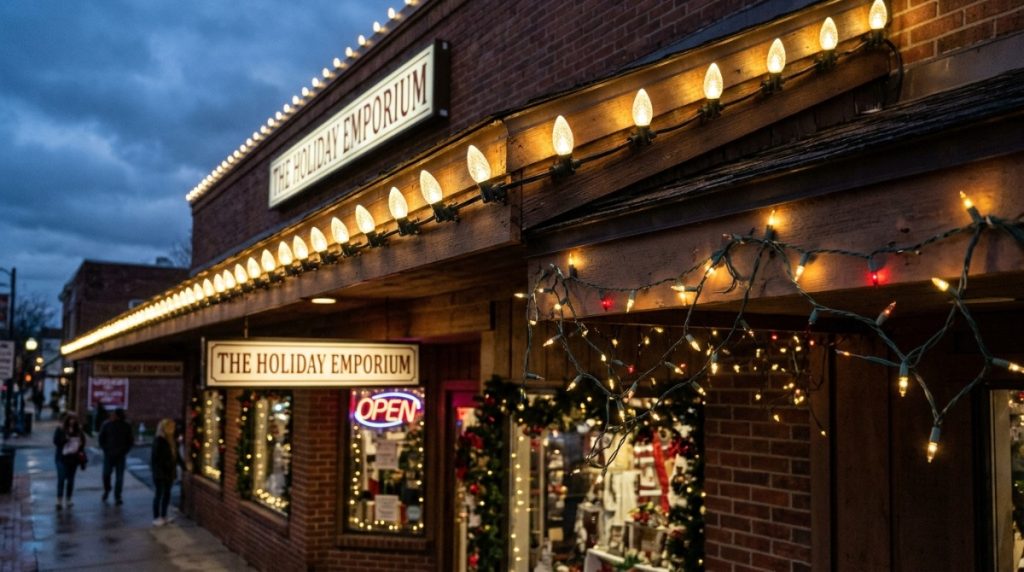
What Is the Difference Between Commercial-Grade and Store-Bought Christmas Lights?
Commercial-grade Christmas lights use thicker wire, sealed one-piece sockets, rectified LEDs that do not flicker and tightly matched colors, so they handle snow, rain and cold for many seasons. Store-bought lights use lighter parts made for occasional home use, so they fade, flicker and fail sooner outdoors.
Store-bought lights are not bad. They are simply built for a different job. Here is commercial-grade vs store-bought Christmas lights in one quick table.
| Feature | Commercial-grade | Store-bought |
| Wire | Heavier, commonly 18 to 20 gauge | Often thinner |
| Sockets | Sealed, one-piece | Often two-piece, bulb pushes into socket |
| Bulbs and lenses | Tough, UV-resistant | Lighter plastic, fades and cracks sooner |
| LED driver | Often full-wave rectified, no visible flicker | Often non-rectified, can flicker |
| Color consistency | Tightly matched bulb to bulb | Can vary box to box |
| Weather sealing | Built for outdoor exposure | Varies widely |
| Replaceable bulbs | Yes, on C9 and C7 strings | Often molded in |
| Expected service life | Built for many seasons | Often one to three seasons |
| Who maintains it | Your installer, all season | You and your staff |
| Who stores it | Your installer | Your back room or basement |
How Are Commercial-Grade Lights Built Differently?
Each difference between commercial-grade vs store-bought Christmas lights sounds small on a spec sheet. On a building facing a Michigan winter, they add up.
Heavier wire carries power farther and holds up to handling
Wire is measured in gauge. A lower number means thicker wire.
Commercial strings commonly use about 18 to 20 gauge wire. Many retail sets use thinner wire. Thicker wire carries power over longer runs, which matters on a long storefront roofline. It also holds up better to being clipped, pulled, wound and stored year after year.
Sealed one-piece sockets keep water out
Many store-bought strings use a two-piece design: a bulb pushed into a socket. That joint is where moisture gets in.
Michigan is hard on that joint. Snow melts in the afternoon, refreezes at night, and water works its way into every gap.
On takedown day in January, our crew sometimes inspects storefronts that used store-bought strings the year before. We find green corrosion in sockets and water sitting in plug ends after a mid-winter thaw. Sealed one-piece sockets are built to stop exactly that.
Rectified LEDs do not flicker
Here is the plain English version. Your outlet supplies alternating current, which switches direction many times a second.
Cheaper LED sets switch on and off with it. You may not notice in person, but phone cameras often catch it as flicker. Commercial sets usually use a full-wave rectifier, which smooths that current so the light stays steady.
That matters for a business. Customers take photos and videos of a pretty storefront. You want it to look steady and warm, not flickering.
Tight color binning means every bulb matches
LEDs come off the production line in slightly different shades. Manufacturers sort them into groups called bins. Tight binning means every bulb in the line looks the same.
A Howell restaurant once had three different “warm whites” across its roofline, from boxes bought in different years. From the road, it looked patchy. Our C9 line was one consistent color, every bulb clipped upright every 12 inches on the gutter lip.
A storefront is read from the road. Inconsistency reads as careless.
Tougher lenses and UV-resistant materials
Sunlight and cold are rough on plastic. Cheap lenses fade, cloud and turn brittle, and brittle plastic cracks in a hard freeze.
Commercial lenses are made to hold their color and shape through long outdoor seasons.
Why C9 bulbs on a commercial roofline
C9 bulbs are larger, so they read clearly from the road and parking lot. We use C9 on all rooflines and offer C7 for smaller detail. Every bulb is clipped upright and spaced every 12 inches for a clean, even line.
Why Does Light Quality Matter More on a Storefront Than on a House?
At home, a dead strand is a small annoyance. On a business, it is part of how customers judge you, which is why commercial-grade vs store-bought Christmas lights matters more here.
Your storefront is seen every day by customers, not just neighbors
A house is seen by neighbors and a few passing cars. A storefront is seen by every customer, every delivery driver and every person stuck at the light out front.
Your lights become part of your first impression. When they look sharp, the business looks sharp.
A dark strand on Black Friday weekend costs more than a strand
The busiest shopping days are exactly when you want your storefront looking its best. A strand that dies that weekend does not just look bad. It looks bad to the most people.
Replacing it costs a few dollars. Leaving it dark through the busiest weekend costs you that first impression.
Liability near entrances and sidewalks
Lights on a business hang above doors, sidewalks and parking spaces. A sagging strand or a cord across a walkway is a real hazard for customers.
That is why who installs them matters. We are fully insured and CLIPA certified, and we install with clips designed for the job, not tape and staples.
Staff time on ladders is time off the sales floor
When staff hang lights, they are not helping customers. They are also on a ladder in the cold, which is a risk all its own.
It is one of the big reasons to hire professional holiday light installers for a business.
Why Won’t Elves Install Customer-Owned Lights?
We get this question a lot, and we understand it. You already own the lights, so why not use them?
The honest answer is quality and liability. We know exactly how our lights are built, tested and stored. We do not know that about lights from a box, especially lights that spent a year in a damp basement.
Using only our own commercial-grade LEDs is what lets us offer a full-season warranty and service guarantee. It is also what lets us come back within 48 hours with matching parts when something fails. Because they are our lights, we always have the same bulbs and strings on hand.
Between seasons, our lights live in a heated warehouse, not a storage unit. They come back out clean, dry and tested.
You can read more about how we work on our FAQ page.
When Are Store-Bought Lights Perfectly Fine?
We want to be fair here. Store-bought lights have their place.
They work well for:
- Indoor window displays
- A small tree on the counter
- Short one-night events
- Interior garland and shelving
Indoors, there is no snow, no freeze and thaw, and no ladder. That is where store-bought sets do just fine. The exterior roofline and entry are where commercial grade earns its keep.
Even indoors, check the label. Make sure the lights are lab-tested and rated for where you plan to use them. If you are thinking about your house too, see our residential holiday lighting options.
What Should You Check on the Box if You Buy Your Own?
If you do buy your own lights, a few checks go a long way. These come from U.S. Consumer Product Safety Commission holiday lighting guidance.
- Look for lab testing. Buy lights tested by a nationally recognized lab such as UL.
- Read the label color. A red UL holographic label means the lights are safe for indoor and outdoor use. A green UL label means indoor only.
- Inspect every set. Check new and old sets for broken or cracked sockets, frayed or bare wires and loose connections. Throw out damaged sets.
- Check your extension cords. Make sure they are rated for the use you have in mind, especially outdoors.
- Use GFCI protection. Plug outdoor lights into a GFCI-protected outlet or a portable GFCI.
What Does This Look Like on a Real Storefront?
Back to that Brighton boutique.
Year one, store-bought. Six boxes, hung by staff on a slow Tuesday. By the second week of December, two strands were dark. One box was a cooler white than the rest. Bulbs on the awning pointed every which way. The owner spent the last Saturday before Christmas on a ladder.
Year two, commercial-grade. We put a C9 line along her roofline in warm white, every bulb clipped upright on the edge and spaced every 12 inches. We outlined her front window in warm white and hung a wreath over the door. Everything came from our own stock and our own heated warehouse.
The lights stayed on through the season. She never touched a ladder. In January, our elves took it all down and hauled it away.
What she noticed most was how calm December felt. You can see our finished displays for more examples.
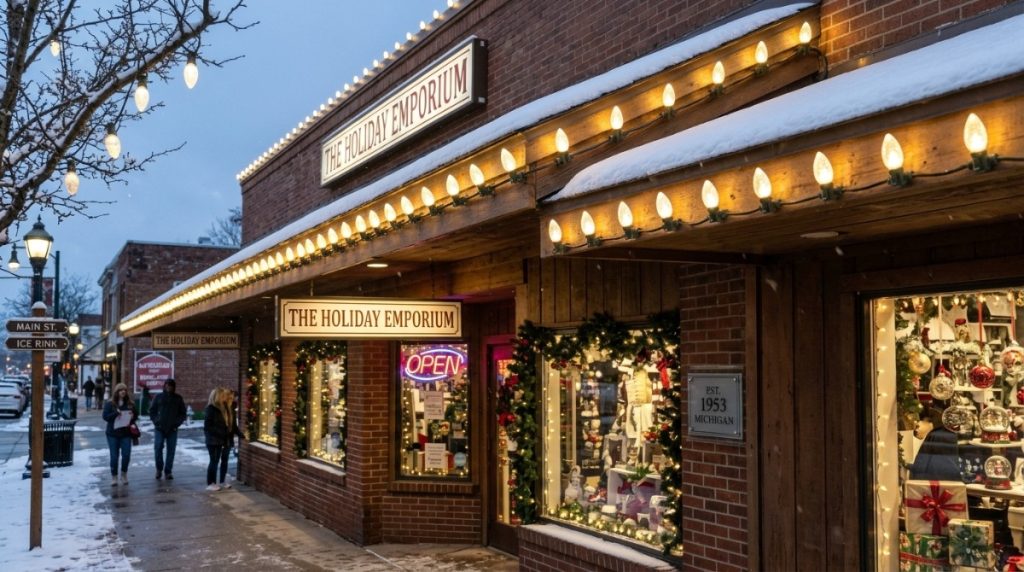
Commercial-Grade vs Store-Bought Christmas Lights in a Michigan Winter
Michigan winters test every part of a light string.
Snow and ice build up on parapets. Wind rips across open plaza parking lots. Salt spray drifts onto storefronts near busy roads like Grand River. And the gutter line freezes and thaws over and over between November and January.
Those are the real test conditions for Livingston County businesses, and they are why we only hang commercial-grade lights on storefronts.
Downtown storefronts on Main Street in Brighton and Grand River in Howell get seen by big holiday event crowds. The lights need to look right on those nights, not just on install day.
We are locally owned in Howell and serve Howell, Brighton, Hartland, Pinckney, Fowlerville, South Lyon, Milford, Wixom, Northville, Dexter, Whitmore Lake and New Hudson.
What Does Commercial-Grade Holiday Lighting Cost?
Our packages start at $1,000. Budget tiers run from $1,000 up to $3,000 and beyond, depending on the size of the building and how much you want lit.
The quote covers the lights, design, installation, maintenance and takedown. No hidden fees. There is no separate light purchase and nothing to store. You start with a free digital rendering, so you see the result before you commit.
Send us a photo of your storefront for a free digital rendering using our commercial-grade C9 and mini lights. No lights to buy, store or replace.
Frequently Asked Questions
What is the difference in commercial-grade vs store-bought Christmas lights?
Commercial-grade lights use heavier wire, sealed one-piece sockets, rectified LEDs and tightly matched colors. Store-bought lights use lighter parts made for occasional home use. Outdoors, commercial lights hold up longer and look more even, while store-bought sets tend to flicker, fade and fail sooner.
Are commercial-grade Christmas lights worth it for a small business?
For the outside of a business, usually yes. Your storefront is seen by customers every day, and dark or mismatched strands make a business look careless. With us, you do not buy the lights at all. They are part of the package, warrantied all season.
How long do commercial-grade LED Christmas lights last?
They are built for many seasons of outdoor use. Manufacturer ratings vary, and how lights are stored matters a lot. Ours are stored in a heated warehouse between seasons and checked before they go back up.
Why do store-bought LED lights flicker?
Most flicker comes from a non-rectified driver. The LEDs switch on and off with the alternating current from your outlet. Commercial sets usually use full-wave rectification, which smooths the current and keeps the light steady on camera.
Can indoor Christmas lights be used outside?
No. Only use lights rated for outdoor use outside. According to the CPSC, a red UL holographic label means indoor and outdoor use, and a green UL label means indoor only. Plug outdoor lights into a GFCI-protected outlet.
Can you install the lights I already own?
No. We only install our own commercial-grade LEDs, for quality and liability reasons. That is what allows us to offer a full-season warranty, a service guarantee and 48-hour repairs with matching parts.
Do I have to buy the commercial lights?
No. We supply the commercial-grade lights as part of your package. You never buy, store or replace them. We take them down in January and store them in our heated warehouse.
What happens if a commercial light fails mid-season?
Call us. We are out within 48 hours if lights fall or bulbs go out, and we bring matching parts because they are our own lights.
Let Our Elves Bring the Commercial-Grade Lights
You run the business. We will handle the lights.
We bring the commercial-grade LEDs, hang them straight, and keep them shining with 48-hour service and a full-season warranty. In January, we take them down and store them in our heated warehouse until next year.
Call or text (810) 522-8950, or get your free estimate and a free digital rendering of your storefront.
Serving Livingston County and surrounding communities.
