
We once pulled up to a house that looked like a simple job in the photo. In person, the roof was steeper and the ridge sat higher than the picture suggested. The plan we made at the office changed on the driveway.
That happens more often than people think. Photos flatten height and pitch. If you are trying to get Christmas lights on a high roof, it helps to know your options before you set a foot on a ladder.
We are Elves Holiday Lighting in Howell, and our crew works at height every season. Here is an honest, safety first guide to what works, what does not and when it is time to stop and call someone.
The short answer
Use the safest tool for the height. A hanging pole works for reachable eaves. A properly set extension ladder with a stabilizer works for single story reach. A lift or a professional crew is the right choice for two story rooflines, steep pitches and roof peaks. Never walk on the roof.
If you are unsure, that uncertainty is a good reason to hire a pro.
Check your roof before you decide
Spend ten minutes on the ground first. It tells you a lot.
Stories, eave height and ridge height
Count the stories. A one story home often has eaves you can reach safely. On a two story home, the eave can sit 18 to 20 feet or more above the ground, and the ridge is higher still.
Also note where the ground slopes. A walk out basement or a hill can add several feet of height on one side of the house.
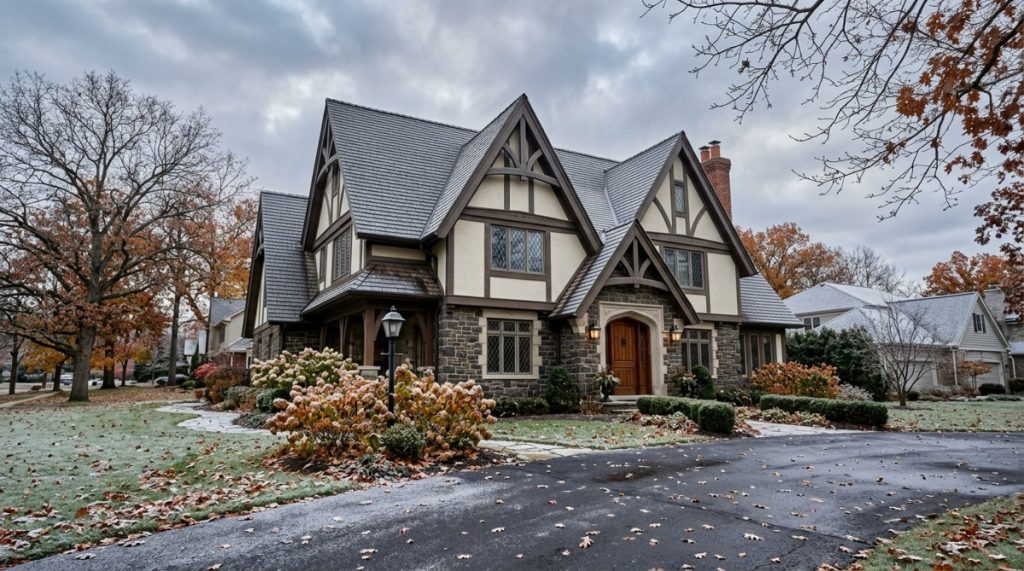
Pitch: how to tell if it is too steep
Roof pitch is described as rise over run, such as 6 in 12. The higher the first number, the steeper the roof. You can read more about how it works in this overview of roof pitch.
A simple test: if the roof looks steep from the street, it is steep. Many roofers treat pitches around 7 in 12 and above as steep. At that point, working near the edge without proper protection is a serious risk.
Surface conditions: frost, wet shingles, leaves
Shingles are slick when they are wet, frosty or covered in leaves. In Michigan, morning frost can linger on a north facing slope well into the day.
If the roof is damp or icy, the job waits.
A five question go or no go checklist
Answer yes or no:
- Can I reach the whole roofline from the ground or from a ladder on level ground?
- Is the roof gentle enough that I would feel safe standing on it?
- Is the surface completely dry and free of frost?
- Is there someone who can spot the ladder and help me?
- Is there a power source near where the lights will be plugged in?
If you answer no to any of these, stop. You have your answer.
Methods for getting lights up high
Each tool changes the risk in a different way.
Light hanging poles for eaves and gutters
A hanging pole lets you place lights from the ground. It is great for reachable eaves and low rooflines. It cannot take you up two stories, and it takes a steady hand.
Extension ladders with stabilizers and footing boards
A ladder gets you higher, but it is also where many injuries happen. Use a ladder stabilizer, which holds the ladder away from the gutter and spreads the load. Set the ladder on firm, level ground, using a footing board if the ground is soft.
A common rule is the 4 to 1 angle: for every 4 feet of height, the base sits 1 foot away from the wall. Never lean a ladder on a gutter without a stabilizer, because gutters bend and slip. The basics are well covered in this overview of the ladder.
Roof peak clips and how peaks are really reached
Peaks are the hardest part of any job. Some homeowners use a pole with a special clip to reach them from a ladder. On a tall house, that means working at the very top of your reach.
In our experience, peaks are where most do it yourself plans fall apart. They are high, they are steep and they leave little room for error.
Aerial lifts and bucket access
A lift gets a worker to the roofline without a ladder or a walk on the shingles. It is the safest way to reach a tall eave or peak. Lifts need level ground and clearance, and renting one is a real expense.
Fall protection: when harnesses and anchors apply
Harnesses and anchors are for roof work, and they must be used correctly. A harness tied to nothing does nothing. If a job needs a harness, that is usually a sign the job is best left to trained people.
Mistakes that hurt people and roofs
These are the ones we see most:
- Overreaching. Leaning past the side rails is one of the fastest ways to fall. Move the ladder instead.
- Leaning a ladder on the gutter. It can bend the gutter and slide.
- Staples and nails. They poke holes in shingles and trim and can lead to leaks.
- Hanging lights while they are plugged in. Always unplug before you handle them.
- Working in wind. Michigan wind off open fields can push a ladder and a person off balance.
- Going alone. A second person to foot the ladder and watch makes a big difference.
What a professional crew does differently
Here is a look at how a tall house is handled.
Planning from the ground and measuring first
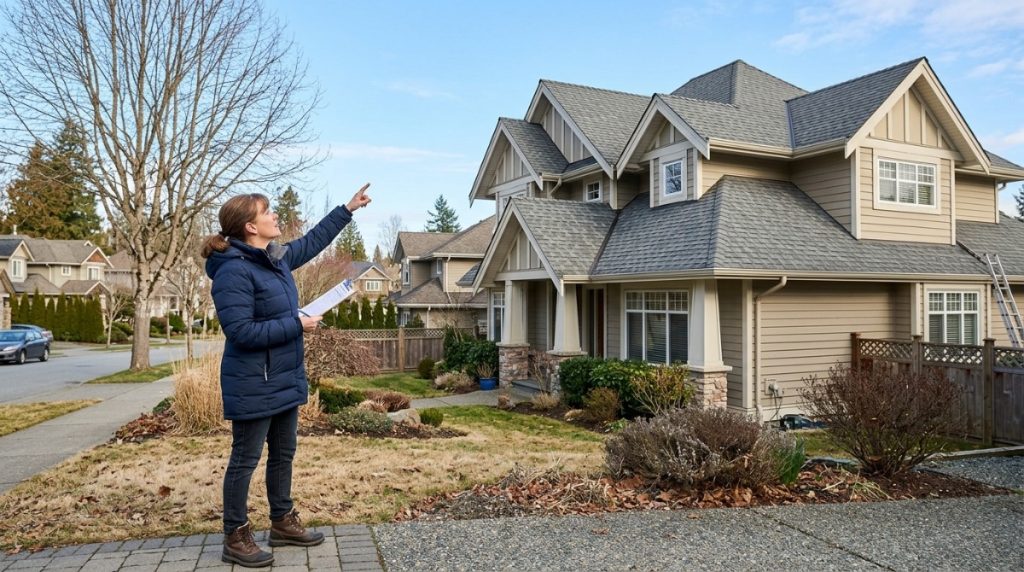
We study the house before anyone climbs. We measure the roofline, note the pitch and height, and decide which equipment fits each section.
Teams of two or more, spotting and staging
Our crew works in teams. One person works while another spots and hands up equipment. Nobody hurries.
C9 runs, clips matched to the surface, test before and after
We install commercial grade C9 bulbs on every roofline. Clips are matched to the surface, and the lights are tested before and after hanging. That way, problems get fixed on the day.
Insurance, and why it matters if something goes wrong
We are insured, CLIPA certified and use professional equipment. Insurance matters because accidents, while rare, are costly. A homeowner should never be stuck with that risk.
Practical example: three tall homes
Here is how we think through three common types. Details vary, so this is a general approach.
The two story colonial. The eave is high and straight. This is a job for professional equipment and a crew, not a single ladder. Straight runs go quickly once the right setup is in place.
The steep gable. The pitch is the issue. We plan around it carefully and avoid any work that would put a person on the roof surface. Many homeowners are surprised how much steeper a gable is up close.
The walk out basement on a slope. The ground is the challenge. The house may be two stories on the front and three on the back. Ladder placement is tricky, and level footing matters.
In every case, our rule is simple. If a job needs more than a stable ladder and a pole, it needs a lift or a professional crew.
Cost: DIY gear versus hiring
Money is a real part of this decision, so let us talk about it.
What poles, stabilizers and rentals cost
Costs vary by store and season, but as a rough guide:
- A light hanging pole kit often runs from a few dozen dollars to around a hundred.
- A ladder stabilizer is usually under a couple hundred dollars.
- Renting an aerial lift can run several hundred dollars per day, plus delivery and your time to learn to use it.
Add clips, extension cords and the cost of your weekend, and the savings can shrink. Add the injury risk, and the savings are not worth it for many homes.
What a seasonal professional package costs
Many first time Elves customers invest between $800 and $2,000 for a full package. That covers design, installation, maintenance, takedown and storage. Most residential installs take about 2 to 4 hours once the crew arrives.
Michigan conditions that change the plan
Michigan adds its own challenges:
- Cold. Cold hands, slick surfaces and stiff cords slow everything down.
- Wind. Open fields can send strong gusts across a roofline.
- Short daylight. Late fall afternoons get dark early. Rushing at the end of the day is how mistakes happen.
- Ice and frost. Even a thin layer on shingles or a ladder rung is dangerous.
If conditions are bad, wait for a better day. The lights will still be there.
It is okay to stop and hire someone
Many people read guides like this one with a quiet question in mind: is it okay to quit?
Yes. You may have done it last year without a problem. That is a fair point, and it can still be time to stop. Roofs do not get easier as the years go by, and luck is not a plan.
Hiring a professional is not a failure. It is a way to protect your family, your roof and your weekend. A trained crew has the equipment, the insurance and the habit of working carefully, and they do this every day.
If you do not feel comfortable with strangers on your roof, that is also reasonable. Ask any company about their insurance, their equipment and their process. A good installer will be happy to explain, and will not pressure you.
Frequently asked questions
Can I hang lights without a ladder?
Yes, in some cases. A hanging pole can place lights on reachable eaves from the ground. For second story rooflines and peaks, a pole alone usually will not reach safely.
How steep is too steep?
If the roof looks steep from the street, it is too steep for most homeowners. Many roofers treat pitches around 7 in 12 and higher as steep. If you would not feel safe standing on it, do not work on it.
Do I need a harness?
If a job requires you to work on the roof surface, you need proper fall protection and training. For most homeowners, the better answer is to avoid roof work altogether.
How long does installation take?
Most residential installs take about 2 to 4 hours once the crew arrives. Larger or more complex homes can take longer.
Does hiring a pro include takedown?
With Elves, yes. Our packages include design, installation, maintenance, takedown and storage in our heated warehouse.
Send us a photo of your home
If your roof is tall, steep or complicated, send a photo of the front of your home. We will tell you what the install involves and design it with a free digital rendering. There is no pressure, and you will know what to expect.
Learn more about our residential holiday lighting, read our FAQ or contact us for a free estimate. You can also call us at (810) 522-8950.
