
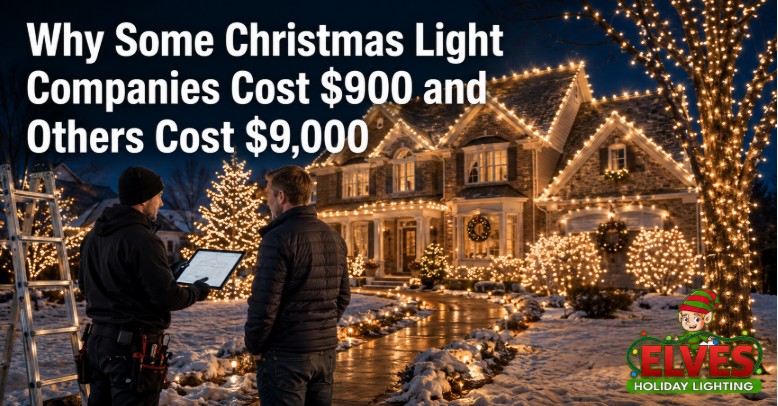
One week last season, we ran two estimates in Brighton just a few streets apart. The first homeowner slid a $900 quote across the kitchen counter. The second had a $9,000 proposal from a metro Detroit design firm sitting on hers.
Both asked us the exact same question: “Is this normal?”
Both numbers were real, and neither company was scamming anyone. Christmas light installation prices really do run from $900 to $9,000 in this market, because the companies behind those numbers are selling completely different things. We sit in the middle of that spread, which gives us a clear view of both ends. Here is what actually drives it.
Why Christmas Light Installation Prices Range From $900 to $9,000 (Direct Answer)
Christmas light installation prices vary tenfold because companies sell different things. A $900 job is usually labor-only or a short front roofline. A $2,000 job is full-service: commercial-grade lights, design, repairs, takedown and storage. A $9,000 job adds whole-property scope, custom or animated displays, large tree wraps and design-build service. Product grade, scope, service model, overhead and positioning drive the spread.
The five drivers, in order:
- Product grade
- Scope of the display
- Service model
- Overhead you cannot see
- Market positioning and demand
Once you can spot these five in a quote, no number will confuse you again. Let us take them one at a time.
The Five Drivers Behind the Price Spread
Driver 1: Product Grade (Retail Strands vs Commercial C9 LED vs Custom RGB)
Retail strands from a box store cost $30 to $50 each and fail often. Commercial-grade C9 LED, the product we install, costs several times more per foot, burns brighter, and survives Michigan winters. At the top sits custom RGB and permanent-style systems, where the product alone can run thousands.
Same roofline, three products, three very different numbers before anyone touches a ladder.
Driver 2: Scope (Front Roofline vs Whole Property and Landscape)
A $900 job usually lights 100 to 150 feet of front roofline. A $9,000 job lights the whole property: full ridgelines, every elevation, wrapped trees, bushes, walkways, sometimes the fence line. Scope multiplies footage, product, and crew hours all at once, which is why it moves price faster than any other driver.
Driver 3: Service Model (Labor-Only vs Full-Service vs Design-Build)
Labor-only sells an afternoon of installation on your lights, at $2 to $7 per foot. Full-service sells a whole season: lights, design, repairs, takedown, and storage in one number. Design-build firms sell a custom creative project with site visits, engineering, and animation programming.
You are not comparing prices between these, you are comparing products. We wrote a full breakdown of what sits inside each format in how a christmas light quote is built.
Driver 4: Overhead You Cannot See (Insurance, Trained Crews, Warehouse, January Callbacks)
The $900 operator often has none of this. Liability insurance, workers’ comp, crews trained for steep roofs, a heated warehouse for storage, and staff who still answer the phone in January all cost real money before a single house gets lit.
Our 48-hour repair promise is a good example. Keeping crews available all season for callbacks is expensive, and it is baked into every mid-tier quote. When a number seems impossibly low, this is usually the layer that is missing.
Driver 5: Market Positioning and Demand
Some companies price to win volume, some price for exclusivity. A design firm serving metro Detroit estates charges estate prices, because its calendar fills with fewer, larger projects. A side-gig installer prices low because his overhead is a ladder. Neither is lying. Each number tells you who the company is built to serve.
The Same House at $900, $2,000 and $9,000 (Practical Example)
Take a two-story colonial in Brighton, the house we quote more than any other. Here is what each budget actually buys on it.
What $900 Buys on a Two-Story Colonial
Labor-only installation of lights you purchased, covering the front roofline, or a small full-service package on a short eave line. No repairs when a strand dies, takedown maybe, storage no. It looks good on install day, and staying that way through February is your job.
What $2,000 Buys on the Same House
A full-service season. Commercial C9 LED custom-cut to the front elevation and gables, a digital rendering approved before install, insured crew, repairs within 48 hours, January takedown, and heated storage. This is the tier we build most, and most first-year homes here land between $800 and $2,000.
What $9,000 Buys on the Same House
The whole property becomes the display. Full ridgelines and all elevations, four or five large trees fully wrapped, lit bushes and walkways, possibly RGB color-changing systems with programmed scenes. A designer manages the project end to end. It is a different product for a different goal, and on the right corner lot it is spectacular.
| $900 | $2,000 | $9,000 | |
| Product | Your retail strands | Commercial C9 LED | Commercial LED plus custom RGB |
| Coverage | Front roofline | Front elevation and gables | Whole property and landscape |
| Who fixes outages | You | Installer, 48-hour promise | Design firm, on call |
| Takedown | Sometimes extra | Included | Included |
| Storage | No | Included, heated warehouse | Included |
| How it looks in January | Depends on your ladder time | Maintained until takedown | Maintained until takedown |
When the Cheap Option Is Actually Right
We will say what most installer blogs will not: sometimes $900 is the correct answer.
A single-story ranch with a simple roofline, a tight budget, an owner who does not mind a ladder, and lights already in the garage is a fine labor-only job. If a strand dies and you are comfortable fixing it, you are not missing much.
The cheap tier goes wrong when the house is tall, the roof is steep, or the buyer assumed repairs and takedown were included. Match the tier to the house and the household, not to pride or to fear.
When Paying More Is Worth It
The middle tier earns its price in specific situations. Two-story homes and steep pitches, where every ladder trip carries real risk. Corner lots and visible streets, where a half-dark roofline in January shows. Busy households that want exactly one phone call all season.
What the extra money buys is not brighter bulbs, it is the season: someone insured on the roof instead of you, a warranty on every socket, outages fixed within 48 hours, and lights taken down and stored without a single Saturday lost. That is the product. For large properties and businesses that need the top tier, our commercial holiday lighting work covers the bigger canvases.
Questions That Reveal Which Tier a Quote Belongs To
Any quote answers six questions, even by staying silent:
- Who owns the lights?
- Who fixes outages, and how fast?
- Is takedown included?
- Is storage included?
- Is the number fixed in writing?
- Is the company insured, with proof?
A quote answering one or two of these is bottom tier, whatever it costs. All six with standard scope is mid tier. All six plus whole-property scope and custom design is the top tier. Run every number you collect through these six and the spread sorts itself in about two minutes.
FAQ
Why is professional christmas light installation so expensive?
Because the price carries more than labor: commercial-grade lights, insurance, trained crews, in-season repairs, takedown, and storage. Labor is often the smallest slice of a full-service number.
What does a $9,000 christmas light display include?
Typically whole-property coverage: full rooflines on every elevation, multiple large tree wraps, landscape and walkway lighting, sometimes RGB animation, with design-build project management and full-season service.
Are expensive christmas light companies better?
Not automatically. Expensive usually means bigger scope and higher-grade product, not better workmanship. Judge any company by the six questions above and by reviews, not by the size of the number.
What is the cheapest way to get lights professionally installed?
Buy your own lights and hire a labor-only installer for the front roofline, typically $2 to $7 per foot. Just budget honestly for replacements, takedown, and your own ladder time, because none of that is in the price.
What tier do most Livingston County homes choose?
The middle. Most homes we serve invest $800 to $2,000 for a full-service front-elevation display, with larger and custom projects running $3,000 and up.
Find Your Home’s Right Tier (CTA)
If you are holding two numbers that are thousands of dollars apart, the fastest fix is a free consultation. We will measure your home, build a digital rendering, and tell you plainly which tier fits, including “you do not need us for that” when a simple ranch and a labor-only installer are the honest answer.
Elves Holiday Lighting serves Brighton, Howell, Hartland, and all of Livingston County, Michigan. Call (810) 522-8950 or request your free quote through our contact form.
