
Christmas lights on your house are a low fire risk when you use outdoor-rated lights in good condition, plug them into a GFCI-protected outlet, and attach them with clips instead of staples. Most of the trouble we see outside comes from old or damaged strands, overloaded outlets and wet connections. Modern LED lights run cooler and draw far less power, which lowers the risk even more.
Last November a family in Hartland called us with a simple question. The year before, they had hung their own lights: a mix of old incandescent C9 strands and newer mini lights, stapled along the fascia.
Everything ran from one porch outlet through two extension cords lying in the snow along the driveway. During the coldest week of December, the outlet kept tripping. One plug end felt warm in their hand.
Nothing burned. But it made them nervous enough to ask us, “Was that a fire hazard?”
Honestly, what they had was the most common pattern behind exterior light problems. The good news is that every piece of it is fixable. Below, we cover what the safety data says, what actually makes a setup risky, a 60-second check you can do tonight, and what Michigan winters add to the picture.
Are Christmas Lights a Fire Hazard? The Short, Honest Answer
So, are Christmas lights a fire hazard? They can be, but Christmas lights on your house carry a low risk when the setup is right.
Lights rarely fail on their own. The problems start with how they are treated: the condition of the strand, how much power you pull through one outlet, how the lights are attached, and whether water gets into the connections.
It also helps to keep the risk in proportion. Most holiday fires that make the news start indoors, with dry trees, candles and decorations placed too close to heat. Exterior lights are a smaller part of that picture.
For most homeowners, the bigger outdoor danger is actually the ladder. More on that below.
The four things that turn lights into a hazard:
- Damage: cracked insulation, crushed wire, broken sockets, corroded plugs
- Overload: too many strands on one outlet or one cord
- Poor attachment: staples, nails or wraps that pinch the wire
- Water: plugs and connections sitting in snow, slush or standing water
Fix those four and you have handled almost everything that matters.
What Do the Safety Numbers Actually Say?
Where most holiday fires really start
Fire safety groups have tracked holiday fires for years, and the pattern stays the same. Christmas tree fires and decoration fires mostly begin inside the home.
Candles, decorations set near a heater or fireplace, and dry trees are the usual starting points. When electrical gear is involved, it is usually a damaged cord or an overloaded outlet, not a healthy light strand doing its normal job.
What that means for the lights outside your house
Christmas lights on your house sit outdoors, away from candles, space heaters and fireplaces. That removes the biggest indoor triggers.
What is left is electrical: worn strands, too much load on one circuit, and moisture in a connection. Those are exactly the things you can check and control, which is why the rest of this post focuses on them.
The risk most people overlook: the ladder
Here is the number that surprises people. According to the U.S. Consumer Product Safety Commission, about 14,900 people were treated in emergency rooms for holiday decorating injuries in the 2023 holiday season (Nov. 1, 2022 to Jan. 31, 2023).
That works out to about 160 decorating injuries a day during the season. Nearly half of them involved falls.
So if you are weighing risks this year, the climb deserves at least as much respect as the cords.
What Actually Makes Outdoor Christmas Lights Risky?
Are old or damaged light strands dangerous?
Yes, damaged strands are the most common problem we find. Look for cracked or brittle insulation, crushed wire, loose or broken sockets, bent prongs and corroded plugs.
Strands that spent the year in a hot attic or a damp basement wear out faster than you would expect. If a strand is damaged, toss it. Taping it is not a fix.
When you replace lights, look for a recognized testing lab mark such as UL or ETL, and make sure the package says the set is rated for outdoor use.
How many light strands can you plug into one outlet?
Follow the tag. Every light set lists how many sets can be connected end to end, and that number is the limit.
The CPSC’s long-standing tip is simple: never string together more than three sets of incandescent lights, and never overload electrical outlets. The Electrical Safety Foundation International (ESFI) adds a practical rule: match the power needs of your lights to the amperage rating of the extension cord.
If a plug or cord feels warm, like the Hartland family’s did, that is a sign you are asking it to carry too much.
Why LEDs change the math
An older incandescent C9 bulb draws several watts on its own. LED versions draw a small fraction of that and run much cooler to the touch.
That means far more bulbs can run on one circuit with less heat at the plug, the cord and the bulb itself. You still follow the tag, but the margin is much bigger.
Can you staple or nail Christmas lights to your house?
No. Staples and nails can pierce or pinch the insulation, and that damaged spot is where a short or a fault starts. ESFI warns against mounting or supporting light strings in any way that could damage the cord.
On first visits to older Brighton colonials, our crew often finds staples driven right through the wire. We also see lights wrapped around metal gutter hangers and strands tucked down into gutters packed with oak leaves.
None of that is needed. With professional roofline installation, nothing has to pierce the wire at all.
What safe attachment looks like
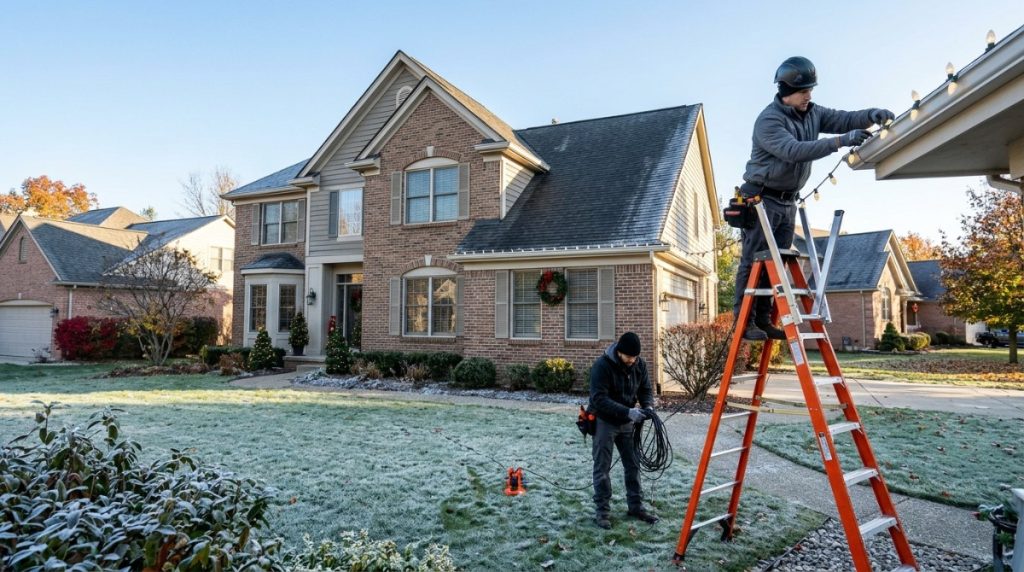
Use plastic light clips that hold each bulb on the gutter lip or shingle edge. Bulbs should sit upright and evenly spaced. Our elves clip every C9 every 12 inches, so the line stays straight and the bulbs sit clear of the gutter trough.
Do you need a GFCI outlet for outdoor Christmas lights?
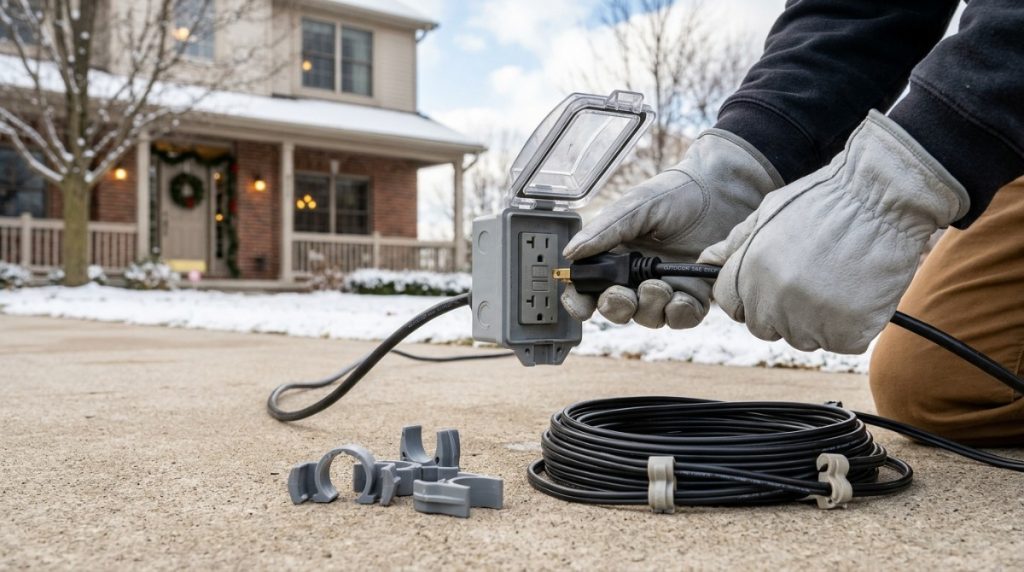
Yes. ESFI recommends plugging outdoor lights into circuits protected by a ground fault circuit interrupter. A GFCI cuts power in a fraction of a second when it senses current leaking where it should not, such as through water.
If your outdoor outlet is not protected, portable outdoor GFCIs are available. A weatherproof in-use cover keeps rain and snow off the plug while it is in use.
One important point: a GFCI that keeps tripping is doing its job. It is telling you there is water or a fault somewhere. Never get around it by running a cord through a window or door to an indoor outlet.
Are extension cords a fire risk outside?
They can be when they are the wrong type or treated badly. Use only cords marked for outdoor use.
Do not pinch cords in doors, windows or garage door seals, which crushes the wire over time. ESFI also says to keep extension cords and light strings clear of snow and standing water.
Fewer cords and shorter runs are always better.
Are LED Christmas Lights Safer Than Incandescent?
Generally, yes. LEDs run much cooler at the bulb and draw far less power, so you need fewer outlets and fewer cords to light the same roofline. Less load means less heat at every connection.
That matters on a Michigan roofline in late fall, when gutters can still hold a layer of dry leaves.
LEDs are not fireproof, though. A crushed LED strand or a wet connection can still fault. Cooler bulbs lower the risk, but they do not replace good condition and good installation.
There is also a real difference between store-bought and commercial-grade LED lights. Commercial-grade sets usually have thicker wire, better sealed sockets and sturdier connectors that hold up to wind and cold.
That is why we install only our own commercial-grade LED lights, never customer-owned strands. We want to know exactly how every strand was made, tested and stored before it goes on your roof with our name on it. You can read more about how our elves install and maintain your lights on our FAQ page.
Is It Safe to Leave Outdoor Christmas Lights On All Night?
The safest habit is to turn them off. ESFI’s guidance is to turn off all indoor and outdoor electrical decorations before leaving home or going to sleep.
The easy way to follow that is a timer. Set your lights to come on at dusk and switch off at bedtime. You get the glow when people are actually driving by, and you save electricity and wear on the lights.
If you prefer to keep them on later, the setup above matters even more: undamaged outdoor-rated lights, a GFCI-protected outlet, clips instead of staples, and connections kept dry.
What Do Michigan Winters Do to Christmas Lights?
Livingston County winters add a few challenges for Christmas lights on your house that you will not find in most safety articles.
Snow, slush and freeze-thaw
A December thaw followed by a hard freeze is tough on connections. A plug lying flat on the ground ends up under slush, then under ice.
Last season a homeowner with a ranch near the Pinckney lakes went through exactly this. After a thaw and refreeze, a connection on the ground was sealed in ice and the GFCI tripped. To “fix” it, he ran the cord into the garage outlet through the door seal.
We lifted the connections off the ground and away from the downspout, and the tripping stopped. A GFCI trip is a warning, not a nuisance.
Wind and ice on the roofline
Open lots and lake areas around Hartland, Pinckney and Whitmore Lake catch stronger gusts. Loose strands rub against shingles and gutters, sag and slowly fray.
ESFI recommends fastening outdoor lights securely to the house, trees or other firm supports to protect them from wind damage. Tight clips at even spacing keep the line from whipping around all winter.
Leaves in the gutters
Much of Livingston County is oak and maple country, and gutters often still hold leaves when lights go up. Clips that hold bulbs on the gutter lip, not down inside the trough, keep the bulbs clear of that dry debris.
Ladders on frozen ground
ESFI’s ladder advice is worth repeating: use wood or fiberglass ladders, extend them at least three feet past the roof edge, and keep yourself and your equipment at least 10 feet from power lines.
Frozen, uneven ground in November makes a stable setup harder. If the climb is the part that worries you, here are a few more reasons to hire professional holiday light installers.
A 60-Second Check: Is Your Setup One of the Risky Ones?
Run through this list before you plug in the Christmas lights on your house this year.
- Any strand that is old, cracked or has a loose socket? Replace it.
- Lights attached with staples, nails or tape? Switch to plastic clips.
- More connected sets than the tag allows, or lots of strands on one outlet? Spread the load or switch to LED.
- Outlet without GFCI protection or a weatherproof cover? Add a portable outdoor GFCI and an in-use cover.
- Cords pinched in a door, window or garage seal? Reroute them.
- Connections lying in snow or near a downspout? Lift them and move them.
- Bulbs sitting inside a leaf-filled gutter? Clear the gutter and clip to the lip.
- Lights left on all night with no timer? Add a timer.
One “yes” means fix that item before the lights go back on.
If more than one was a yes and you would rather not deal with it, send us a photo of the front of your home for a free quote.
How a Pro Install Makes Christmas Lights on Your House Safer: A Real Example
Back to the Hartland family. Here is what changed when our elves took over their roofline.
- The lights: their mixed old strands stayed in the basement. We installed our own commercial-grade LED C9s on the roofline, with C7s where a smaller bulb fit better.
- The attachment: clips on the gutter lip, bulbs upright, 12 inches apart. Not one staple.
- The power: we planned the runs so no outlet was overloaded, and kept every connection off the ground.
- The bushes: free-draped mini lights, never net lights.
- The season: worry-free maintenance. If lights fall or bulbs go out, our crew is out within 48 hours.
- The end: takedown after the holidays and storage in our heated warehouse, so the strands are not crushed in a cold garage all year.
A Howell family with gutter guards asked us a fair question: would clips damage the guards? That is exactly why the gutter guard question is on our quote form. The crew picks a clip and placement that suits the guard, so the lights stay secure without forcing anything.
We are fully insured and CLIPA certified, and you can see finished homes in our gallery.
Rather skip the ladder, the cords and the guesswork? Our elves install our own commercial-grade LEDs, check on them all season and take them down when you are done. Free estimate, free digital rendering: (810) 522-8950.
Frequently Asked Questions
Can Christmas lights start a fire on the outside of a house?
Yes, but it is uncommon when the lights are outdoor-rated, undamaged, clipped in place and plugged into a GFCI-protected outlet. The usual triggers are damaged insulation, overloaded outlets or cords, staples through the wire, and water in a connection. Check those four things each year and the risk drops a lot.
Do LED Christmas lights cause fires?
LED lights run much cooler and draw far less power than incandescent lights, so they are a lower fire risk. They are not risk-free, though. A crushed LED strand, a cracked socket or a wet connection can still cause a fault, so inspect them the same way you would any other lights.
Is it safe to leave outdoor Christmas lights on overnight?
Safety groups such as ESFI recommend turning off outdoor decorations before going to sleep or leaving home. The simplest fix is a timer that turns your lights on at dusk and off at bedtime. You keep the look, save electricity and reduce wear.
How many strands of Christmas lights can I connect together?
Follow the maximum printed on the tag or box. The CPSC says never string together more than three sets of incandescent lights. LED sets usually allow more connections because they draw so little power, but the manufacturer’s limit still applies.
Why does my outdoor GFCI keep tripping with Christmas lights?
Usually it is moisture in a connection or a damaged strand. Unplug everything, dry and lift the connections off the ground, then plug strands back in one at a time to find the bad one. Replace the faulty strand. Never bypass the GFCI with an indoor outlet.
Can rain or snow make Christmas lights dangerous?
Water in plugs and connections is what causes faults. Use outdoor-rated lights and cords, a weatherproof cover on the outlet, and keep every connection off the ground and away from downspouts. That is especially important in Michigan, where snow, slush and ice come and go all winter.
Is it safe to use Christmas lights from 10 years ago?
Maybe, but inspect them closely first. Replace anything with cracked or brittle insulation, loose sockets or corroded plugs. Older incandescent sets also run hotter and draw more power, so you can plug fewer of them together. Many families find it is simply time to upgrade.
Does Elves install my own lights?
No. We install only our own commercial-grade LED lights, for quality and liability reasons. That is what lets us back every install with a full-season warranty and service guarantee.
Want Lights Without the Ladder or the Guesswork?
Christmas lights on your house are one of the best parts of a Michigan winter. Check your setup, fix anything on the list above, and enjoy the glow.
If you would rather hand it over, our elves take care of design, installation, maintenance, takedown and storage. Upload a photo of the front of your home and we will send a free estimate and a free digital rendering, so you can see the look before anyone climbs a ladder.
Call or text (810) 522-8950, or get your free estimate online. Our calendar fills quickly starting in October, so it pays to book early.
Serving Livingston County and surrounding communities.
