
The Short Answer
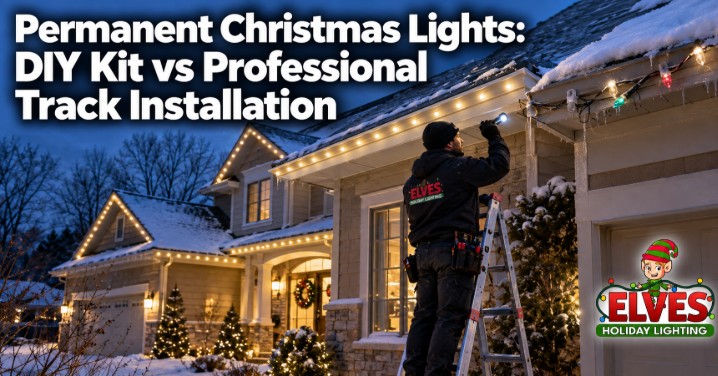
DIY permanent Christmas light kits cost $300 to $1,100 in hardware for a typical roofline, while professional track installation runs $4,500 to $6,500 for the same footage. The LEDs are often comparable. The difference is mounting, sealing, warranty and labor. A DIY kit screwed into proper aluminum track and carefully sealed can last. Adhesive and plastic-clip mounting in Michigan cold usually does not.
That is the permanent christmas lights diy vs professional debate in five sentences. The rest of this post is the evidence.
Quick disclosure so you know whose advice this is. Elves Holiday Lighting installs neither DIY kits nor dealer track. We install professional seasonal displays around Livingston County, which means we spend every season on the same fascia boards and eave heights this decision lives on. We referee this one with no dog in the fight.
And we will say something the dealer blogs will not. Some of the best-looking permanent installs we drive past are DIY. Every one of them has the same thing in common, and it is not the brand of LEDs.
The Four Real Options (Not Two)
The internet frames this as a $500 kit against a $5,000 system. On real driveways we count four options, and the two in the middle are the most interesting.
Option 1: DIY kit as boxed, $300 to $500
Govee-class hardware stuck up with the adhesive strips and plastic clips in the box. Cheapest entry, fastest weekend, and the mounting is the whole risk. Stock adhesive and clip mounting commonly starts failing within 1 to 2 years, and Michigan cold accelerates it.
Option 2: DIY kit plus aluminum track you install, $450 to $1,100
Same kit, but you skip the adhesive and screw proper aluminum track kits, roughly $140 to $170 per run set, into the fascia. This is the sleeper option. Done patiently, it removes the number one failure mode for a few hundred dollars and a longer weekend.
Option 3: Contractor-installed DIY hardware, $1,800 to $2,800
You buy the kit, a contractor mounts it properly at height. You get screwed track, straighter lines and someone who owned the install, without dealer pricing. The warranty is still the kit’s short one, so know what you are buying.
Option 4: Dealer track system installed, $4,500 to $6,500

JellyFish, Trimlight, EverLights class systems through a local dealer. Premium hardware, powder-coated channel, the strongest warranties in the category, and a business attached to the outcome. Who builds what is covered in our permanent lighting brands comparison.
| Option | Typical cost | Mounting | Warranty | Realistic lifespan outlook | Michigan winter fit |
| 1. Kit as boxed | $300 to $500 | Adhesive and plastic clips | 1 to 2 years | Often 1 to 2 winters before mounting issues | Weak |
| 2. Kit plus aluminum track | $450 to $1,100 | Screwed aluminum track | 1 to 2 years on electronics | Years, if sealed and maintained | Good with discipline |
| 3. Contractor-installed kit | $1,800 to $2,800 | Screwed track, pro workmanship | Kit warranty plus installer labor terms | Solid mid path | Good |
| 4. Dealer track system | $4,500 to $6,500 | Powder-coated aluminum channel | Up to lifetime parts terms | Longest, with dealer service | Strongest |
Costs are market ranges from published kit, track and dealer pricing. Whether any of them pencil out for your tenure is a separate question, worked through in our guide to whether permanent Christmas lights are worth it.
What the Extra Money Actually Buys
Between Option 1 and Option 4 sits about $5,000. Here is where it actually goes, item by item.
Mounting: screwed aluminum vs adhesive and plastic
We have rehung enough roofline hardware to state this plainly. The LEDs almost never decide the outcome. The mounting does. Screwed powder-coated aluminum holds through snow-slide shear and deep cold. Adhesive lets go quietly, one warm-cold cycle at a time, and plastic clips turn brittle right when winter peaks.
Sealing and wiring discipline
A pro install seals connector joints and leaves drip loops so water runs away from every entry point. A rushed install of identical hardware skips both, and freeze-thaw finds the gap by February. This is workmanship, not parts, and it is invisible in the box price.
Warranty: 1 to 2 years vs lifetime terms
Kit warranties run 1 to 2 years on electronics, and they do not cover your mounting. Dealer systems carry up to lifetime parts terms with a labor period attached. Read both closely, but understand you are comparing a gadget warranty to a building-product warranty.
Design, straight lines and hidden wire runs
From the street, the giveaway is never the brand. It is a line that wanders off level across a gable, or a power cable looping down a corner in daylight. Pros chalk their lines and hide their runs. Patient DIYers can too. Impatient ones cannot, and the house wears it.
Someone to call in year three
When a section dies in year three, Option 4 owners call the dealer. Option 3 owners call the contractor. Option 1 and 2 owners climb the ladder themselves or start paying by the visit. Price that honestly against your own patience.
The Honest DIY Skill Self-Test
We respect good DIY. These four questions decide whether that is you. Answer them honestly, not aspirationally.
- Are you comfortable working at your eave height for a full weekend, including the awkward spots a ladder does not love?
- Can you run and hide low-voltage wiring cleanly, including powering and weatherproofing the controller?
- Will your lines read straight from the street, on the gables and not just the easy front run?
- Will you actually reseal and check mounts each fall, every fall?
Four yeses genuinely point to Option 2, and we mean that. Any no points to Option 3 or 4, and it is far cheaper to admit that in October than in February.
Two Rooflines, Two Outcomes
Two houses we pass on our winter routes around Livingston County settle this better than any spec sheet.
The first is a DIY job we would happily put our name on. The owner spent the extra weekend screwing aluminum track dead level, sealed every joint, and tucked the controller under a soffit. Three winters on, it still looks dealer-installed from the road.
The second was the same class of kit, stuck up in October warmth with the adhesive from the box. By the second winter the run was peeling off the fascia in a slow wave, clips in the snow below it. The owner got quotes to redo it properly at $1,800 to $2,800, on top of the roughly $500 already spent and the dead weekend. Starting at Option 3 would have cost less than that failure path in both money and pride.
That redo math is the quiet trap in this decision. A failed cheap install does not cost $500. It costs $500 plus the professional job you buy afterward anyway.
Michigan Winter Changes This Math

Everything above gets harsher when the thermometer drops. Many budget kits are rated to around the minus 4 degrees F class, while premium systems publish minus 40 degrees F class ranges. Adhesives and plastic clips go brittle exactly when Howell hits its coldest nights, and snow sliding off a roof shears surface-mounted hardware sideways.
None of this is a reason to skip DIY. It is a reason to refuse adhesive mounting in this state, whatever tier you buy. The full mechanism-by-mechanism breakdown is in our guide to permanent Christmas lights in Michigan winters.
FAQ
Are Govee permanent lights as good as JellyFish or Trimlight?
The light output and app are closer than the price gap suggests. The gap is everything around the LEDs: mounting hardware, weather sealing, temperature ratings, warranty length and a dealer who answers the phone. Judged as diodes, respectable. Judged as a ten-year building product on a Michigan roofline, different class.
How long do DIY permanent christmas lights last?
As boxed, with adhesive and clips, mounting issues commonly appear within 1 to 2 years in cold climates. The same electronics screwed into aluminum track and resealed each fall can run for years. Lifespan follows the mounting method far more than the brand on the box.
Can I pay someone to install a Govee kit?
Yes. Handymen and lighting contractors install customer-supplied kits for roughly $1,800 to $2,800 on a typical home. You get professional mounting with budget hardware, which is a fair middle path, as long as you accept the kit’s short warranty and confirm who services it later.
Is DIY track installation hard on a two-story house?
This is where most self-assessments fail. Working track dead level at two-story eave height, around gables, for hours, is a different sport than a single-story front run. If your honest answer to the eave-height question was a maybe, a two-story home turns it into a no.
What fails first on cheap permanent light kits?
The mounting, almost always. Adhesive backing lifts, plastic clips crack in deep cold, and sections sag or drop. Water intrusion at unsealed connectors comes second, and controller or power issues third. Actual LED failure is far down the list, which is exactly why the mounting decides this whole debate.
Get an Honest Read on Your Roofline
Before you spend $500 or $5,000, get an opinion from people who work these rooflines with nothing to sell either way. We will assess how hard your specific home is for a DIY install, tell you what a fair professional track quote looks like using current market pricing, and price our seasonal no-ladder alternative next to both.
Call Elves Holiday Lighting at (810) 522-8950 or book your free consultation. Whichever option you pick, pick it with open eyes.
